Travel expense policy template for finance teams



A travel expense policy usually breaks on the first exception, whether that is a hotel over the nightly cap, a rideshare without a receipt, or a conference trip with a couple of personal days added. A strong policy tells employees what to do before they spend, and it tells finance exactly what records to collect when expenses are submitted.
That’s why a Canadian travel expense policy has to do two jobs at once:
- Read clearly enough that an employee can book business travel without asking finance five questions.
- Collect enough detail to support reimbursement, CRA records, GST/HST recovery and payroll treatment when a trip includes personal costs.
Why travel policies drift
Travel policies fail when they rely on vague advice instead of spelling out the decision an employee must make before spending. “Use reasonable hotels” sounds flexible, but it can create a situation where the traveller, their manager, and finance are debating the rule after the invoice arrives.
“The exceptions are where the real cost hides. A policy that just says ‘be reasonable’ means every trip becomes a negotiation after the fact and by then, you’ve already lost the leverage to enforce it.” — Sean Lim, Controller at Float
Your policy should remove that debate by naming:
- Who approves the trip
- What limit applies
- Required receipt type (itemized vs. non-itemized)
- When the expense report is due
Why does specificity matter? For Canadian teams, travel expenses connect directly to tax records. According to the CRA, a business expense is a cost incurred for the sole purpose of earning business income, and expense claims need a receipt, invoice or other voucher that supports the expenditure.
A policy that never asks for business purpose, approver or tax detail pushes that work into month-end close.
What your travel expense policy should cover
Before you fill in reimbursement limits, start with the decisions that determine whether an expense is allowed, approvable, taxable and properly documented.
Define the policy scope
The first section of the policy should define the scope. Start with the people covered by the policy, including employees, executives, contractors, board members, volunteers and candidates travelling for interviews.
Then define the trip types that qualify. A useful policy names travel between offices, customer or supplier visits, conferences, training, fieldwork and company events, and then states whether commuting, remote-work location changes and optional team gatherings fall outside the policy.
This section should also assign roles before money moves:
- Traveller: Books approved travel, follows limits and submits receipts
- Manager: Confirms the business purpose and approves the trip or exception
- Finance: Reviews GST/HST details, reimbursement eligibility and coding
- Executive approver: Reviews international travel, business-class flights or out-of-policy costs
The template should include a business purpose field for every trip. A line as simple as "Purpose of trip: [client meeting / conference / site visit / training / other]" gives finance the record it needs and gives managers a clearer reason to approve or reject spend.
Set pre-trip approval
Pre-trip approval belongs in the policy whenever travel involves cost, risk or tax ambiguity before the employee books. A small taxi receipt can be reviewed after the fact, but an expensive flight with an extra weekend attached needs pre-approval.
Use approval triggers instead of asking employees to guess; the policy should name the booking events that need approval and the approver for each event, such as:
- Any overnight trip
- Any flight, train or rental vehicle booking
- Any trip expected to exceed $[amount]
- Any international or US travel
- Any conference, offsite or training registration above $[amount]
- Any booking outside the standard flight, accommodation, meal or ground transportation limits
- Any trip that includes personal days, companion travel or vacation before or after the business dates
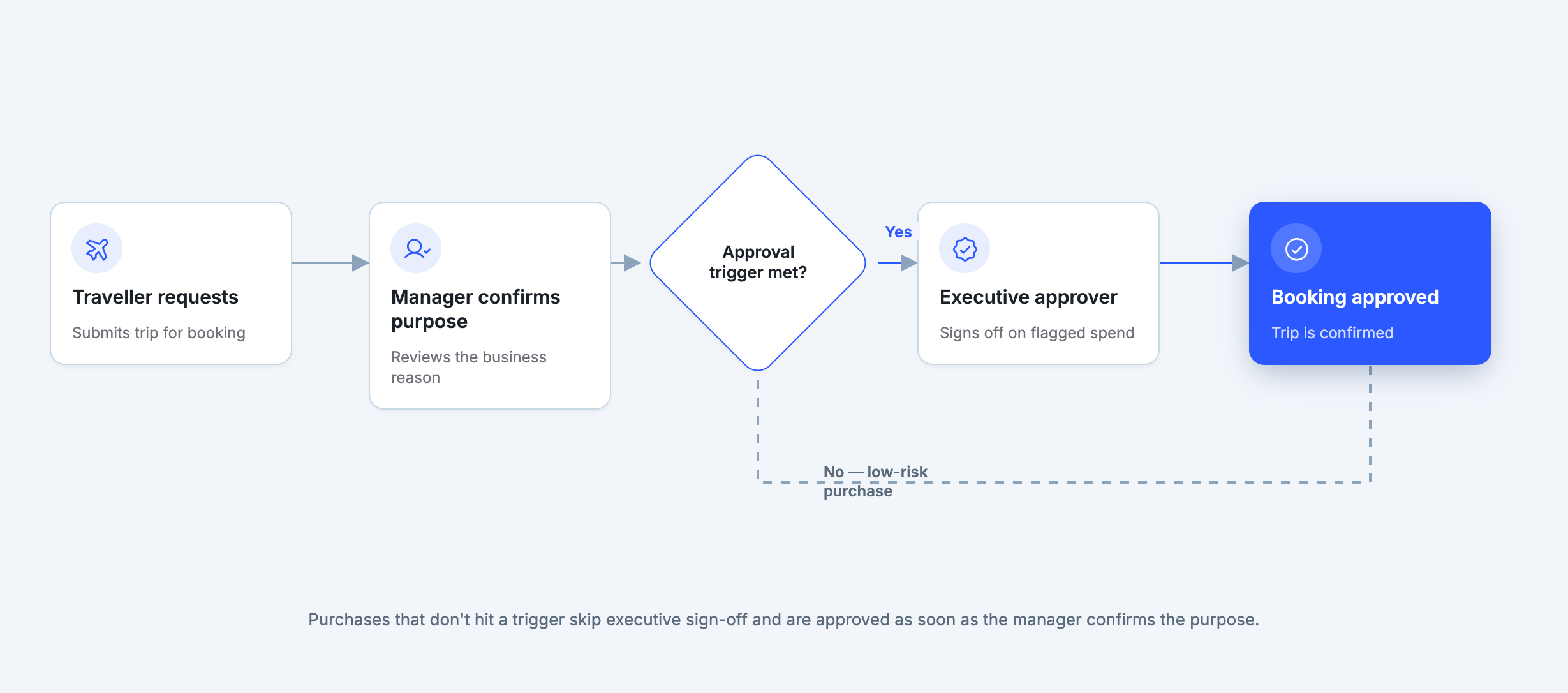
The approval request should capture the traveller, destination, dates, estimated cost, business purpose, cost centre and approver. If your policy allows bookings through a corporate card or travel platform, name the booking method here so employees don’t split spend across personal cards.
Put limits in writing
If employees don’t know the limit, they can’t follow it. Use specific numbers for flights, accommodation, meals, and ground transportation so the right choice is obvious.
Use a table to make the rules easy to scan. Here is an example:
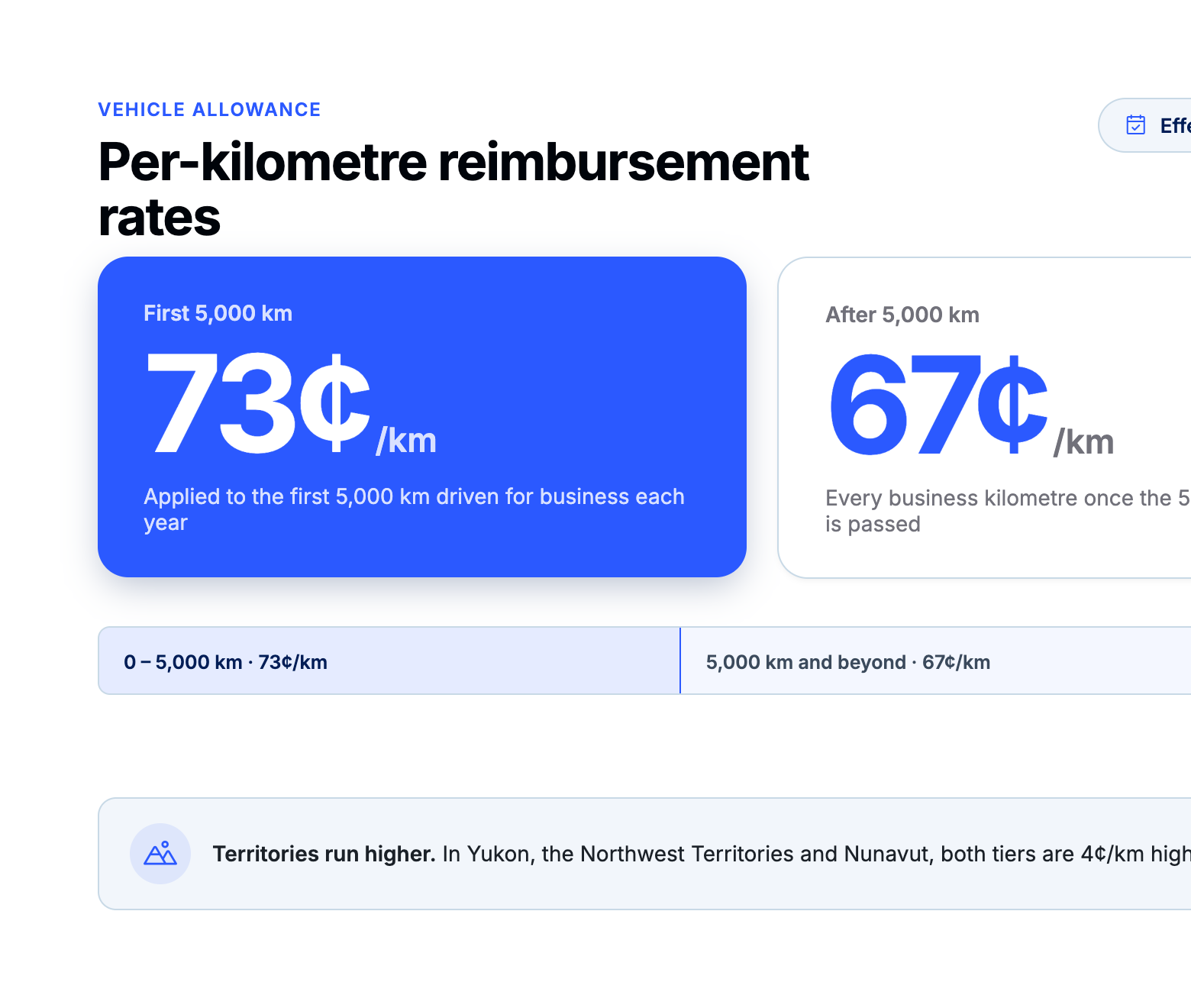
For personal-vehicle use, anchor the policy to the current federal allowance limit and review it annually.
Department of Finance Canada announced that, as of January 1, 2026, the tax-exempt allowance limit in the provinces is 73 cents per kilometre for the first 5,000 kilometres and 67 cents for each additional kilometre.
“We update our internal mileage rate every January because CRA does. Teams that set it once and forget it either under-reimburse employees or leave money on the table at tax time and neither is a great look.” — Rita Bellavia, Financial Operations Manager at Float
The territories use higher limits, so teams with northern travel should confirm the current territorial rates during each annual review.
Make receipts tax-ready
Receipt rules should mirror the records finance needs for CRA support and GST/HST recovery. A corporate card statement proves that money moved, but it usually doesn’t prove what was bought, who bought it, whether GST/HST was charged or why the spend was for business.
The policy should ask for itemized receipts for all reimbursable travel expenses unless finance has approved an exception.
CRA business records says expense receipts should show the purchase date, seller or supplier, buyer, description of goods or services and the vendor business number when the purchase price is $100 or more before tax.
GST/HST input tax credit information requirements get more detailed as the purchase amount rises:
“GST/HST recovery on travel is one of the easiest credits finance teams leave on the table, simply because the receipt didn’t capture the registration number or tax breakdown. It isn’t a compliance issue until it’s a real miss at year-end.” — Sean Lim, Controller at Float
Travel such as hotel, airfare, rail fare and car rental can be eligible for input tax credits when used in commercial activities, while meals and entertainment are handled under separate restrictions.
Add a submission deadline. A practical rule is to require employees to submit all travel expenses within [number] days after the trip ends, and no later than [number] days after month-end.
Short deadlines keep receipts fresh and reduce the chance that GST/HST details get lost in a photo roll or inbox.
Draw the “no” line
A policy needs a clear list of non-reimbursable expenses. Employees should know which costs the company never covers before they travel.
Include a list of costs that are considered personal, punitive or outside the approved trip, such as:
- Seat upgrades, lounge access or priority boarding without approval
- Mini-bar charges, in-room movies, spa services, personal entertainment and sightseeing
- Fines, traffic tickets, parking penalties and lost-item replacement
- Childcare, pet care, house-sitting and personal errands unless an approved program covers them
- Companion travel, family meals and guest costs unless the companion has a documented business role
- Clothing, luggage and toiletries unless required for a specific work purpose and approved in advance
- Expenses submitted after the deadline without an approved exception
“A clear non-reimbursable list actually protects employees, not just the company. Nobody wants to find out at expense review that the company won’t cover the airport lounge pass they assumed was fine.” — Gigi Xian, Manager, People Operations at Float
The policy should also say who can approve an exception, what documentation is required and whether approval has to happen before or after the expense.
For approval, use a simple test: if the exception changes the limit before spend happens, the manager or executive approver signs off before booking. If the exception explains a missing receipt, delayed submission or emergency purchase after the fact, finance reviews the reason and records the outcome.
Handle personal trip days
Personal extensions need their own rule because CRA treats the business and personal portions differently. Employees often add a weekend to a conference or bring a spouse on a work trip, and the policy should clearly separate what the company pays from what becomes personal expense.
“The ‘add two vacation days to a conference trip’ request is the most common exception we see, and it's usually not malicious; most employees genuinely don't realize the tax treatment changes once personal days are added. Requiring the cost comparison up front removes the ambiguity for everyone.” — Sean Lim, Controller at Float
CRA travel expenses guidance says a business-trip allowance or reimbursement is generally non-taxable when the expenses are reasonable, the employee's presence is required to accomplish the trip's business objective and the employee spends more than 50% of the time on business-related activities.
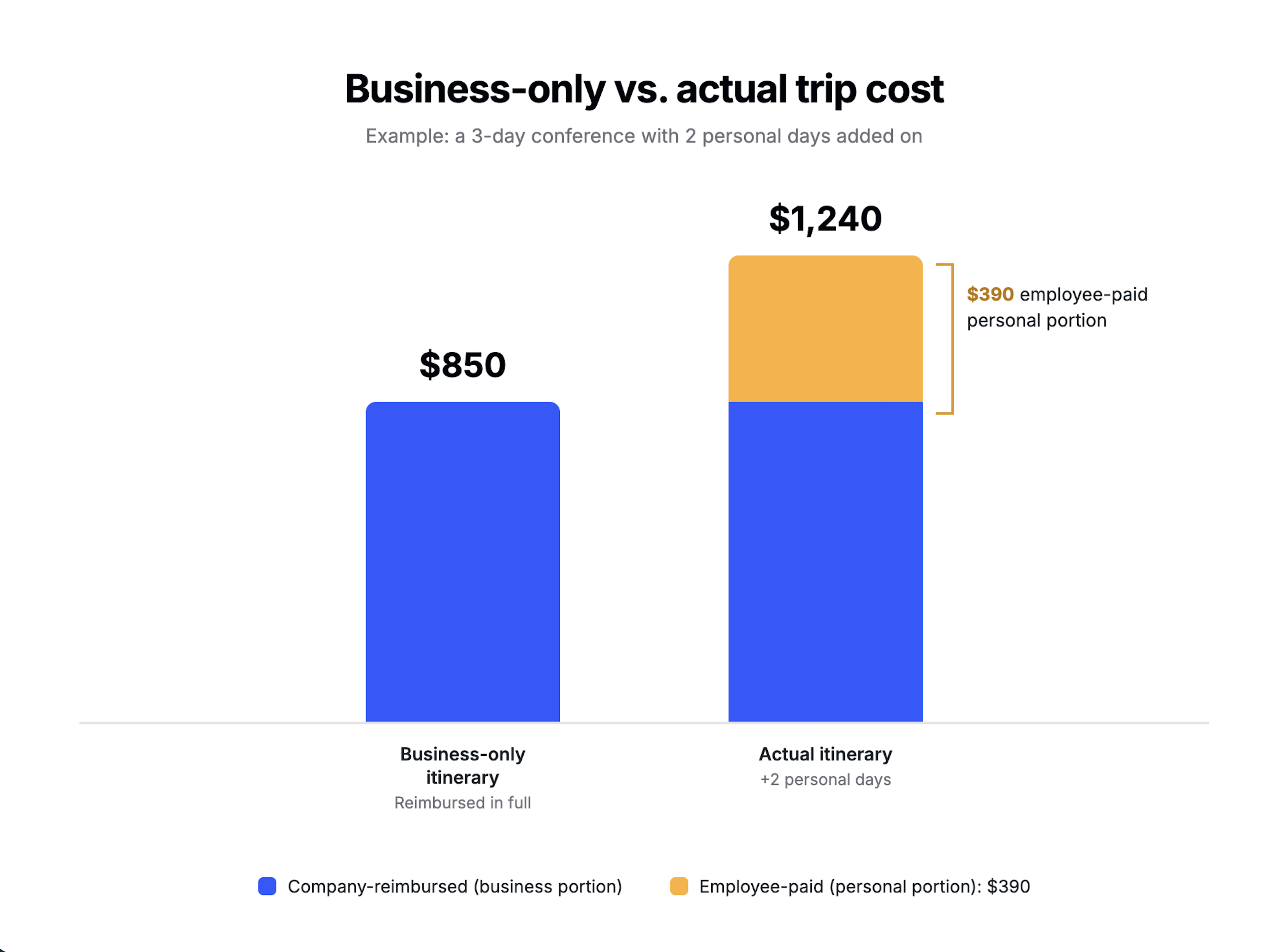
If an employee extends a business trip, CRA guidance treats only the portion of the extension as taxable.
Write the policy so that employees disclose personal days before booking. Require a cost comparison showing the business-only itinerary and the actual itinerary when personal dates change the cost. The company should reimburse only the business portion, and the employee should pay additional lodging, meals, local transportation and companion costs.
Spouse or common-law partner travel needs the same clarity. CRA guidance treats reimbursement for a spouse's travel as a taxable benefit unless the employer requested the spouse's presence and the spouse was mostly engaged in business activities.
Publish the translation
Employees in Quebec need access to the French version of a travel expense policy on terms at least as favourable as any English version. The OQLF's Charter guidance says that employers must use French in written communications with staff and make documents relating to conditions of employment available in French. The OQLF also says companies operating in Quebec have to respect workers' right to carry out activities in French.
For the template, that means the French version should be published at the same time, in the same location and with the same approval status as the English version. If employees acknowledge the policy in an HRIS, intranet or document system, the French acknowledgement path should be equally available.
Companies with 25 or more employees in Quebec over a six-month period also fall under francization requirements and must register with the OQLF no later than six months after that period ends.
Turn policy into controls
A policy works when it shows up at the moment of spend, submission and approval. Sure, a PDF in an onboarding folder helps, but finance still needs the workflow to nudge employees before an expensive choice happens.
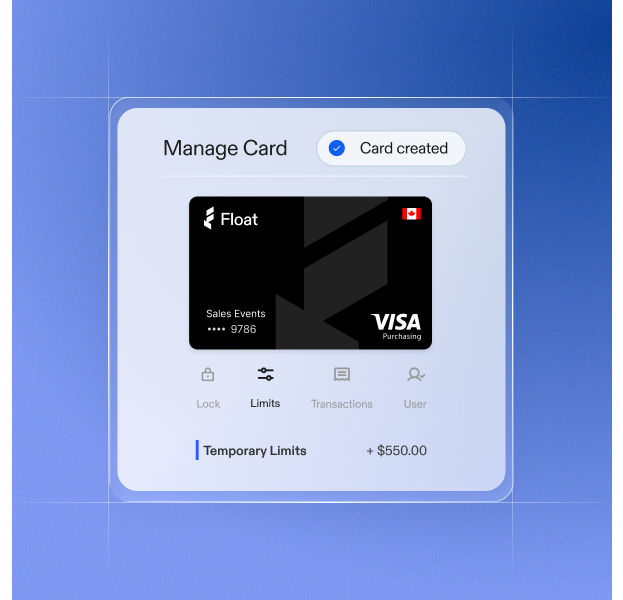
Float cards turn the policy into point-of-spend controls through features such as card limits, merchant category controls and temporary limits for approved trips. For travel, that gives finance a way to set guardrails before costs appear, from hotel holds to last-minute flight changes.
Out-of-pocket expenses still need a clean path because mileage, emergency purchases, and personal card edge cases will always come up. Automated reimbursements gives employees a way to submit those costs with receipts, submission policies and approval workflows, while finance keeps card spend and reimbursable spend in the same operating flow.
Tax capture belongs in the workflow too. Float uses OCR to extract amount, tax amount and vendor details from receipts. And for card transactions, Float Intelligence suggests tax and GL codes from transaction context and historical coding patterns.
“The finance teams who get the most value from card controls set them before the trip, not after the expense report comes in. A temporary limit on a travel card removes the awkward ‘why did you book business class’ conversation entirely.” — Janessa Goulet, Manager, Customer Activation at FloatThat helps finance capture GST/HST detail while the trip is still close enough for employees to fix missing context.

Learn more about Float
Get a 2-minute guided tour through our platform.
Use our template
This template helps finance teams publish an updated travel expense policy quickly by separating the decisions you need to make from the legal and tax language that supports them. Start by setting limits and approvers, then fill in trip types, receipt rules, and reimbursement deadlines.
Use this order to keep the work focused on a few clear decisions:
- Add your company name, effective date, policy owner, and review cadence.
- Define approval triggers for overnight travel, airfare, international travel, and exceptions.
- Set dollar limits for flights, accommodation, meals, ground transportation, and mileage.
- Confirm receipt requirements for CRA records and GST/HST recovery.
- Set the submission deadline and name who can approve exceptions.
- Publish the French version for Quebec employees.
- Configure card limits, reimbursement policies, and approval workflows to match the written policy.
Once the policy is live, review the first month of expense reports for missing receipts, late submissions, and recurring exceptions. Then adjust limits or approval triggers before workarounds become the norm.
Canadian travel expense policy template
[Company name] travel expense policy
Effective date: [Month day, year]
Policy owner: [Finance owner]
Review cadence: [Annual / semi-annual / other]
French version owner, if applicable: [Owner]
1. Purpose
This policy explains how [Company name] employees and approved travellers should request, book, pay for and submit business travel expenses.
The policy is designed to:
- Give employees clear rules before they spend.
- Help managers approve business travel consistently.
- Give finance the records needed for reimbursement, CRA support and GST/HST recovery.
2. Who this policy applies to
This policy applies to:
- [Employees]
- [Executives]
- [Contractors]
- [Board members]
- [Interview candidates]
- [Other approved travellers]
Business travel means travel required for [client work / supplier visits / conferences / training / site visits / company events / other approved business purposes].
Commuting between an employee's home and regular work location is not reimbursable unless [insert approved exception].
3. Roles and responsibilities
4. Pre-trip approval
Employees must get written approval before booking when the trip includes:
- Overnight travel
- Flights, rail travel or rental vehicles
- Expected total cost above $[amount]
- International or US travel
- Conference, training or offsite registration above $[amount]
- Any cost outside the standard limits in this policy
- Personal days, companion travel or vacation before or after the business dates
Approval requests must include:
- Traveller name
- Destination
- Travel dates
- Business purpose
- Estimated total cost
- Cost centre or department
- Approver name
5. Flights and rail
Standard rule: [Economy / lowest logical fare] is required for flights and rail.
Premium economy is allowed when [flight duration threshold / medical accommodation / executive approval].
Business class is allowed only with approval from [approver] when [criteria].
Employees should book at least [number] days in advance unless the trip is urgent.
Change fees are reimbursable only when the change is required for business reasons or approved by [approver].
6. Accommodation
Employees can book accommodation up to:
Hotel receipts must be itemized and show taxes, fees and proof of payment.
Personal charges such as mini-bar, in-room entertainment, spa services and personal laundry are not reimbursable unless approved for a documented business reason.
7. Meals
Meals are reimbursable while employees are travelling for approved business purposes.
Alcohol is [not reimbursable / reimbursable only with client entertainment approval / reimbursable up to $amount].
Tips are reimbursable up to [percentage] when shown on the receipt.
Itemized receipts are required for meal reimbursement unless finance approves an exception.
8. Ground transportation
Employees should use the safest and most appropriate option for the trip. Reimbursable options include:
- Public transit
- Standard taxi or rideshare
- Airport shuttle
- Parking and tolls for approved business travel
- Rental vehicle with pre-trip approval
Luxury rideshare, premium vehicle classes and unnecessary rental upgrades are not reimbursable without approval from [approver].
9. Personal vehicle mileage
Employees using a personal vehicle for approved business travel will be reimbursed at $[rate] per kilometre.
For 2026, the federal tax-exempt allowance limit in the provinces is 73 cents per kilometre for the first 5,000 kilometres and 67 cents per kilometre after that. Finance will review this rate annually.
Mileage submissions must include:
- Date of travel
- Starting point and destination
- Business purpose
- Total kilometres
- Parking and toll receipts, if claimed
Fuel is not reimbursed separately when mileage is paid.
10. Receipts and business purpose
Employees must submit itemized receipts for reimbursable expenses.
Receipts should show:
- Purchase date
- Supplier name
- Amount paid
- Description of goods or services
- GST/HST charged or statement that tax is included, when applicable
- Supplier GST/HST registration number for purchases of $100 or more before tax, when available
- Buyer name, description and payment terms for purchases of $500 or more
Each expense must include a business purpose.
11. Submission deadline
Employees must submit travel expenses within [number] days after the trip ends, and no later than [number] days after month-end.
Late submissions require approval from [approver] and must include a reason for the delay.
12. Non-reimbursable expenses
The following expenses are not reimbursable:
- Seat upgrades, lounge access or priority boarding without approval.
- Mini-bar charges, in-room entertainment, spa services and sightseeing.
- Fines, parking penalties and traffic tickets.
- Childcare, pet care, house-sitting and personal errands unless covered by a separate approved program.
- Companion travel, family meals and guest costs unless the companion has a documented business role.
- Clothing, luggage and toiletries unless required for an approved business purpose.
- Expenses submitted after the deadline without an approved exception.
13. Exceptions
Exceptions must be approved by [approver].
Before-spend exceptions include:
- Premium travel class
- Hotel above the nightly cap
- Rental vehicle without standard pre-approval
- Trip cost above $[amount]
After-spend exceptions include:
- Missing receipt
- Emergency purchase
- Late submission
- Currency conversion issue
Finance will document exception decisions with the expense report.
14. Personal trip extensions
Employees must disclose personal days before booking.
When personal travel is added before or after a business trip, the employee must provide a cost comparison between:
- The business-only itinerary
- The actual itinerary with personal dates
[Company name] reimburses only the business portion. Employees are responsible for additional lodging, meals, local transportation, companion travel and personal activities.
Personal portions of a trip can create a taxable benefit. Finance and payroll will review mixed-purpose trips when required.
15. Quebec French-language version
If this policy applies to Quebec employees, [Company name] will provide a French version on terms at least as favourable as the English version.
The French version will be published at [location] and maintained by [owner].
Employees can request French workplace documents from [contact].
16. Policy acknowledgement
Employees must acknowledge this policy by [HRIS / email / document system] by [date].
Questions should be sent to [finance contact].

Try Float for free
Business finance tools and software made by Canadians, for Canadian businesses.