Expense reimbursement policy template for Canadian companies



An employee buys a $68 client lunch, pays $42 for home internet and drives 147 kilometres to a site visit. Finance now has three questions before reimbursing the claim:
- Do the expenses qualify?
- What proof is enough?
- Do the expenses create tax or GST/HST work?
A good employee expense reimbursement policy answers those questions before anyone submits the claim. For Canadian finance teams, that means clear rules for CRA business-purpose and record requirements, GST/HST input tax credits, the current federal tax-exempt per-kilometre allowance limit, taxable-benefit treatment for allowances and Quebec French language requirements.
If you're here because you need to create or update an expense reimbursement policy, the template below is built so you can replace the placeholders, route it for review and publish it the same day.
The policy needs to start with scope
The CRA reimbursement rules start with purpose. Its travel-expense guidance says, "A reimbursement is an amount you pay to your employee to repay expenses they incurred while carrying out the duties of employment."
That's why a scope clause is the first control in an expense reimbursement policy because it tells employees whose out-of-pocket expenses can be paid back and whose expenses need a different process.
Without this section, every edge case becomes a one-off decision: contractors ask whether the policy applies to them, employees submit expenses from before their start date and managers approve spend that should have gone through procurement.
“Contractor spend is the scope question we get most often. If the policy doesn’t say who it applies to, a contractor’s first expense claim becomes a twenty-minute Slack thread instead of a two-line policy lookup.” — Gigi Xian, Manager, People Operations at Float
Use the scope section to define:
- Eligible people: full-time employees, part-time employees, temporary employees, interns, contractors or board members
- Eligible work: business activities performed for the company, including travel, client meetings, approved remote work, training and role-required supplies
- Excluded workflows: supplier invoices, payroll items, personal benefits, relocation payments, advances and expenses paid on a company card
- Jurisdiction rules: Canadian employees by default, with a separate clause for US employees, contractors or international entities, if any exist
A reimbursement policy should not encourage employees to finance routine company spend on personal cards. If a recurring vendor, subscription or team purchase is predictable, a Float corporate card with limits and submission rules is usually cleaner than asking employees to front the money and wait.
Covered expenses need limits
Covered expenses should be listed by category, with a dollar limit, approval rule and receipt rule for each one. That extra structure stops employees from guessing whether the company treats mileage, home office expenses, client meals and professional development the same way.
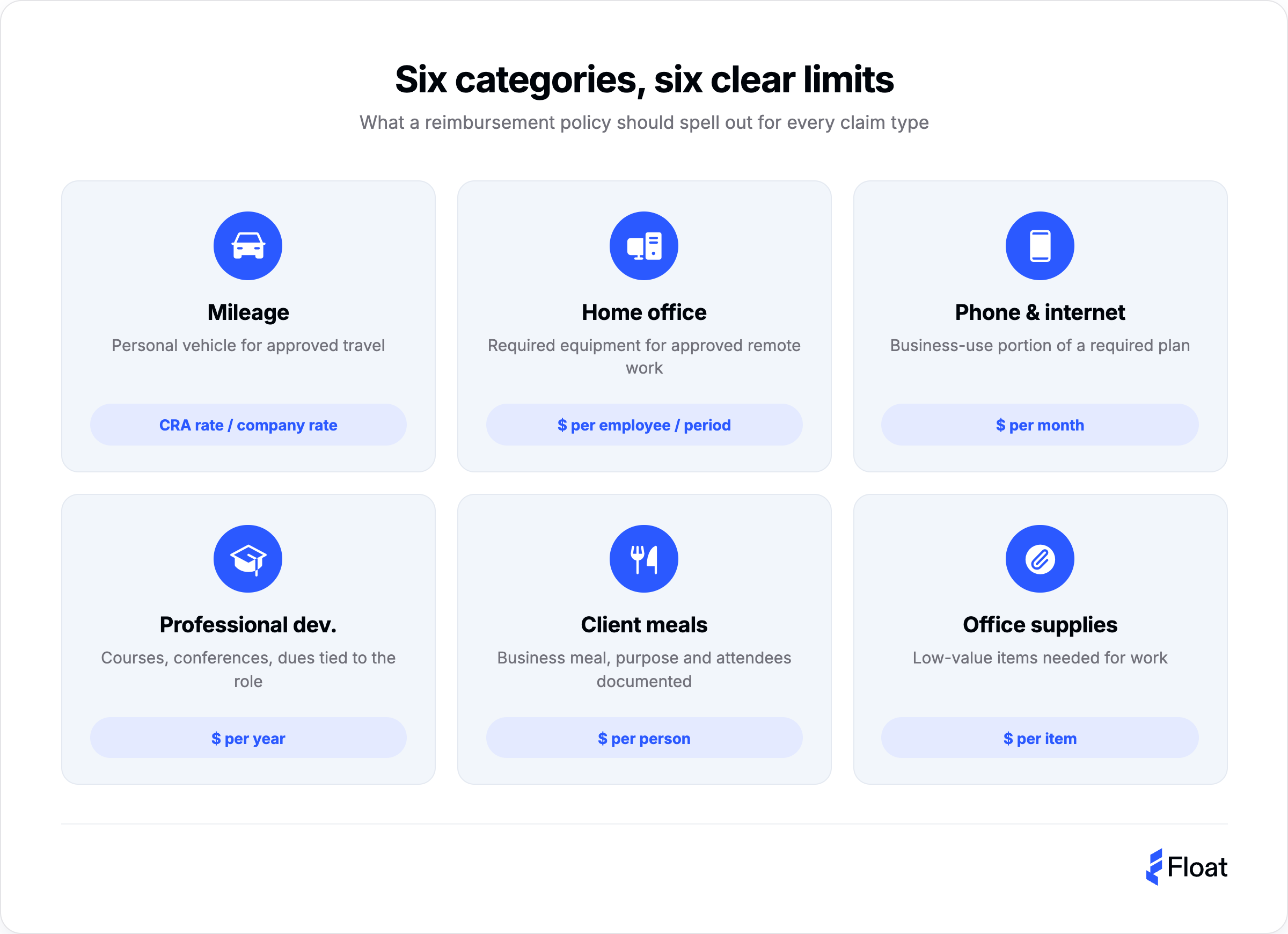
Use a table like this in your policy:
Mileage needs a current rate
Mileage reimbursement for Canadian employees deserves its own line because the rate changes.
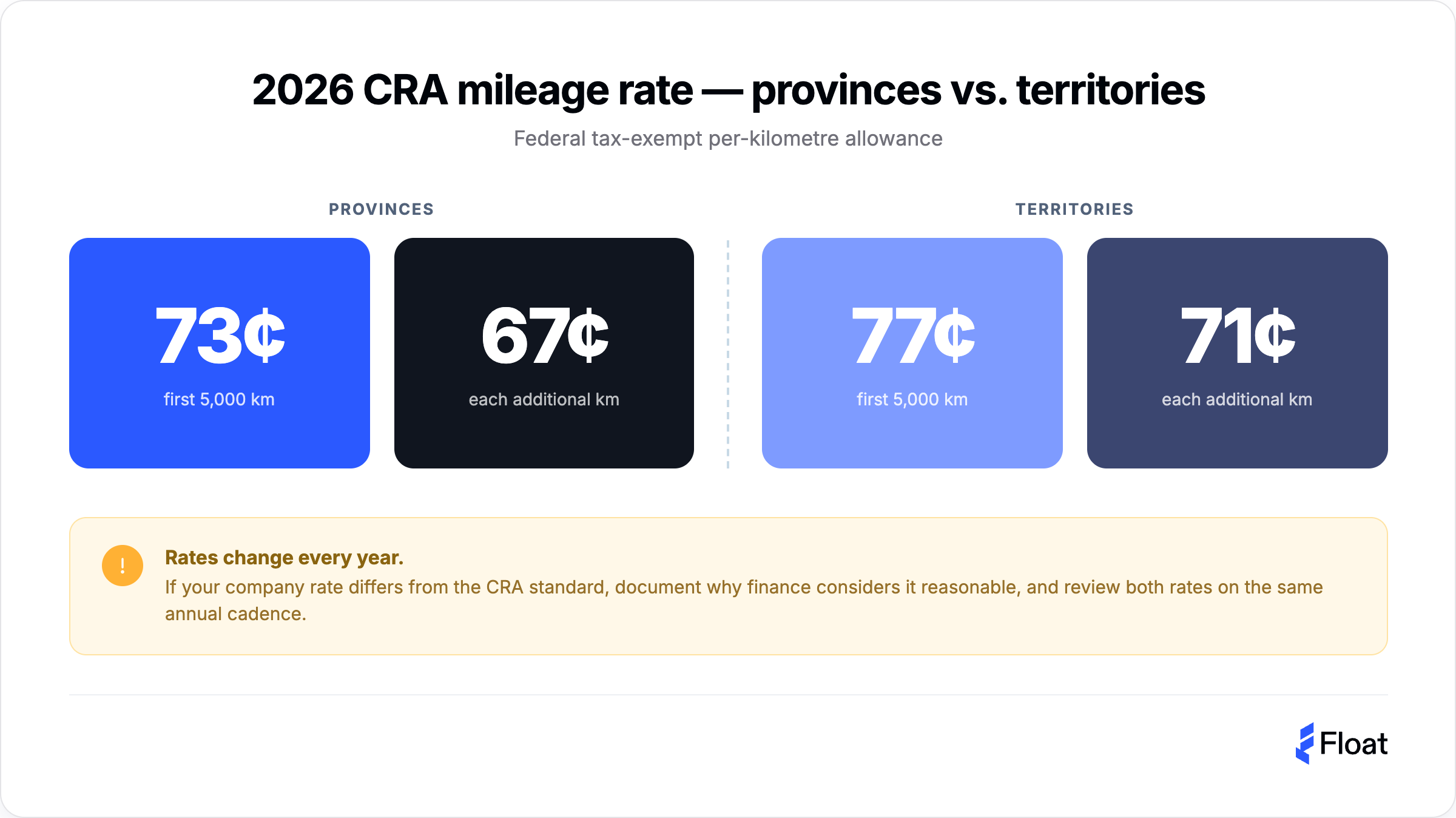
For 2026, the federal tax-exempt per-kilometre allowance limit in the provinces is "73 cents per kilometre for the first 5,000 kilometres driven, and 67 cents for each additional kilometre." The CRA's 2026 mileage table lists $0.77/km for the first 5,000 kilometres in the territories and $0.71/km after that. These numbers also tend to fluctuate every year, so if your company uses a lower or higher rate than the CRA standard, you need to explain why finance considers it reasonable and keep that rationale within the policy.
“We treat the CRA rate as a floor, not a suggestion. Teams that hardcode last year’s cents-per-kilometre into a policy PDF are usually the ones asking finance for a manual adjustment eighteen months later.” — Sean Lim, Controller at Float
Phone, internet and home office need tax rules
Phone and internet reimbursement needs clearer guardrails than most templates provide. The CRA notes that its administrative policy does not apply if you give employees an allowance for mobile phone and internet services. It also states that the business-use portion is not a taxable benefit.
In practice, that means finance can usually defend a receipt-backed reimbursement for the documented business-use portion more easily than a flat monthly stipend with no supporting detail.
A home office stipend needs the same care. In your policy, separate these three cases so employees know what qualifies, what documentation to include, and when payroll may treat something as a taxable benefit:
- Receipt-backed reimbursement for a required item
- Reimbursement for the documented business-use portion of a required phone or internet plan
- Flat allowance or stipend that payroll must review for taxable-benefit treatment
“A flat fifty-dollar phone stipend feels simpler until payroll has to decide whether it’s taxable. A receipt-backed reimbursement for the actual business-use portion takes five more minutes and saves a much longer conversation with CRA later.” — Rita Bellavia, Financial Operations Manager at Float
Clear definitions reduce back-and-forth and help prevent reimbursable expenses from being confused with taxable allowances.
Non-reimbursable means no surprises
A non-reimbursable list prevents the most awkward reimbursement conversation: an employee has already spent the money and only learns after submitting a claim that finance cannot reimburse it. Keep this list plain. Employees do not need tax theory in the policy, they need clear guidance to follow.
Common non-reimbursable expenses include:
- Personal purchases, entertainment or gifts not approved for business use
- Fines, penalties, traffic tickets and parking tickets
- Alcohol, unless pre-approved for a client or company event
- Commute costs between home and the regular workplace
- Unapproved travel upgrades, seat selection fees or lounge access
- Lost, damaged or stolen personal items
- Family, guest or companion costs unless pre-approved for a business purpose
- Expenses submitted after the deadline without an approved exception
- Purchases that should have gone through procurement, bill pay or a company card
The tax reason matters, but it does not have to dominate the employee-facing copy. CRA guidance treats reimbursements and allowances for personal travel or personal expenses as taxable in many situations, so a clean non-reimbursable section protects both the company and the employee. It also gives approvers a rule to point to when they decline a claim.
“A non-reimbursable list only works if it matches what’s actually configured in the expense system. If subscriptions are supposed to go through a company card instead, the policy and the workflow need to agree, or people will default to whichever one is easier.” — Rita Bellavia, Financial Operations Manager at Float
For finance teams, the non-reimbursable list should connect to your system controls. If subscriptions are not reimbursable because they must be purchased centrally, set up the card, purchasing workflow, or approval path that makes central purchasing the easiest option. If client meals over $[amount] require pre-approval, surface that threshold directly in the expense submission flow, not only in the policy PDF.
Receipts protect GST/HST recovery
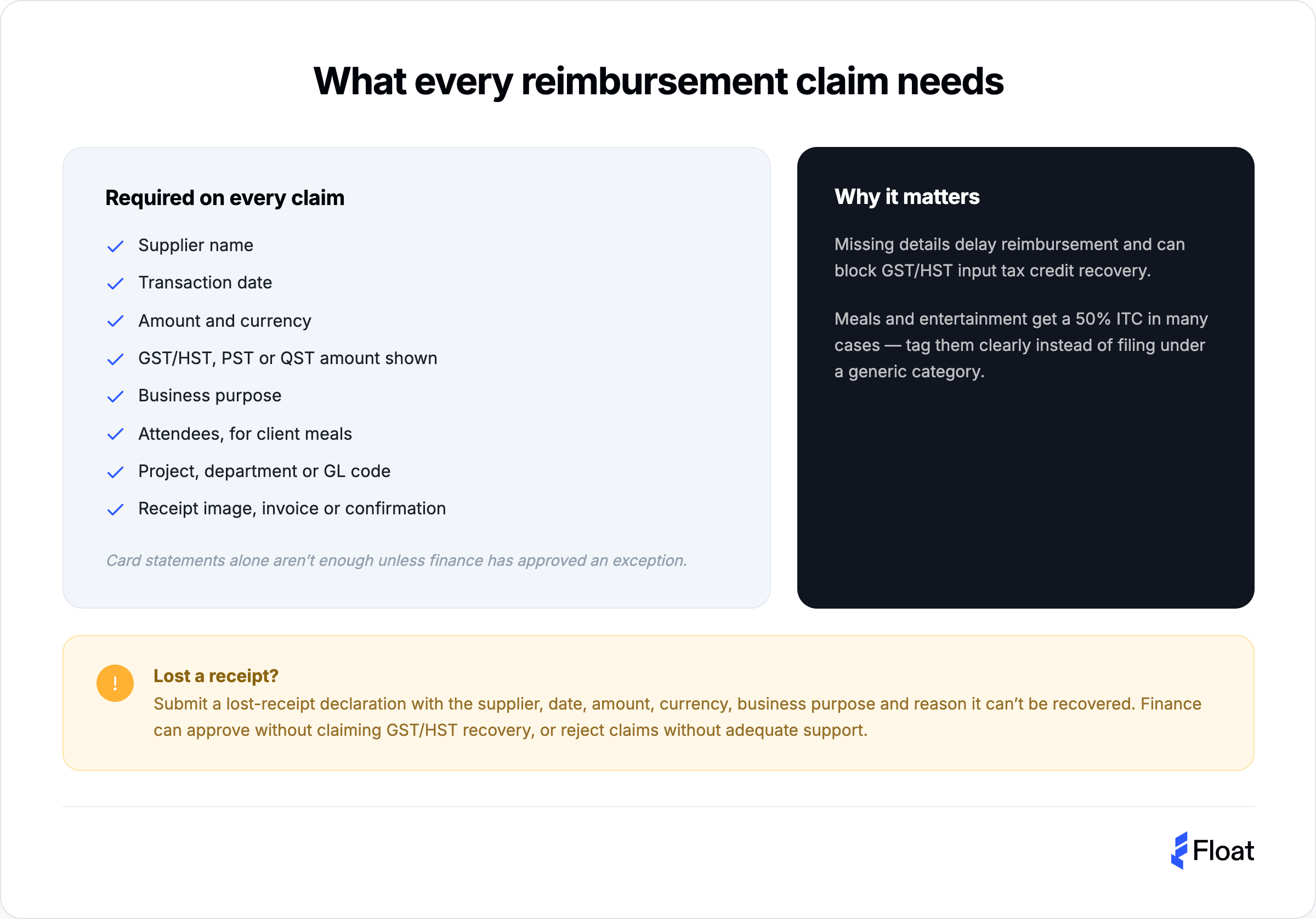
Receipt requirements are not just red tape. When documentation is missing, reimbursements can get delayed and the company may not be able to support GST/HST input tax credits. Employees want to get paid back quickly, and finance needs enough detail to confirm the expense happened, that it was for a valid business purpose, and that any recoverable tax is properly documented.
At minimum, require each claim to include:
- Supplier name
- Transaction date
- Amount and currency
- Any GST/HST and, where applicable, PST or QST amounts shown on the receipt
- Business purpose
- Attendees for client meals
- Project, department, customer or GL code if required
- Receipt image, invoice or digital confirmation
GST/HST recovery
CRA guidance states you can generally claim Input Tax Credits (ITCs) for the GST/HST included in reimbursements you pay to your employees for expenses incurred in Canada on the business's behalf.
The same guidance warns that if documentary requirements are not satisfied, the ITC cannot be claimed until the registrant gets additional support. That’s why it helps to explain the finance rationale behind a strict receipt rule: without a receipt, the company may not be able to support GST/HST recovery.
“GST/HST recovery on reimbursed expenses is invisible until an audit, and then it’s very visible. A missing supplier registration number on a forty-dollar receipt won’t sink you, but a pattern of them across a year adds up to real money left on the table.” — Sean Lim, Controller at Float
Meals and entertainment need a separate note. CRA's ITC method guidance refers to a full ITC (or 50% if meals and entertainment) for reimbursed employee expenses, so the policy should tell employees to clearly identify client meals rather than burying them in a generic "travel" category.
Lost receipts
Add a lost-receipt clause, but keep it narrow:
If a receipt is lost, the employee must submit a lost receipt declaration with the supplier, including the date, amount, currency, business purpose and reason the receipt cannot be recovered. Finance can reject claims without adequate support or approve them without claiming GST/HST recovery.
Workflow support
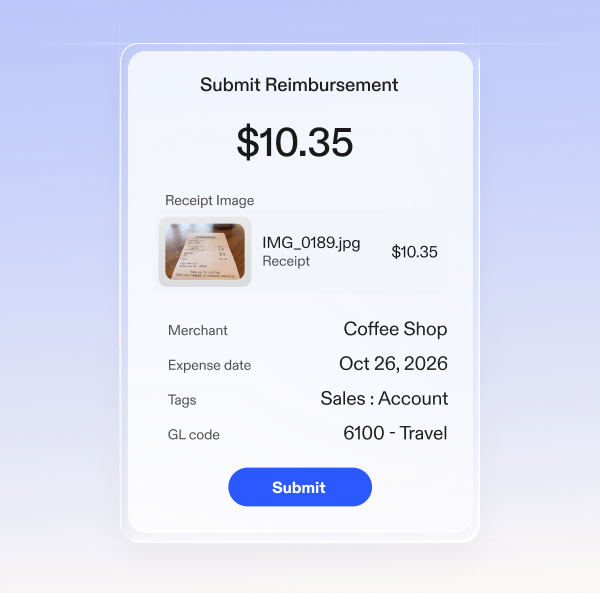
Automated reimbursements brings out-of-pocket expenses and mileage reports into the same submission, approval and payout workflow. The policy still matters, but the workflow can make the compliant path easier than the exception.
Approvals should follow risk
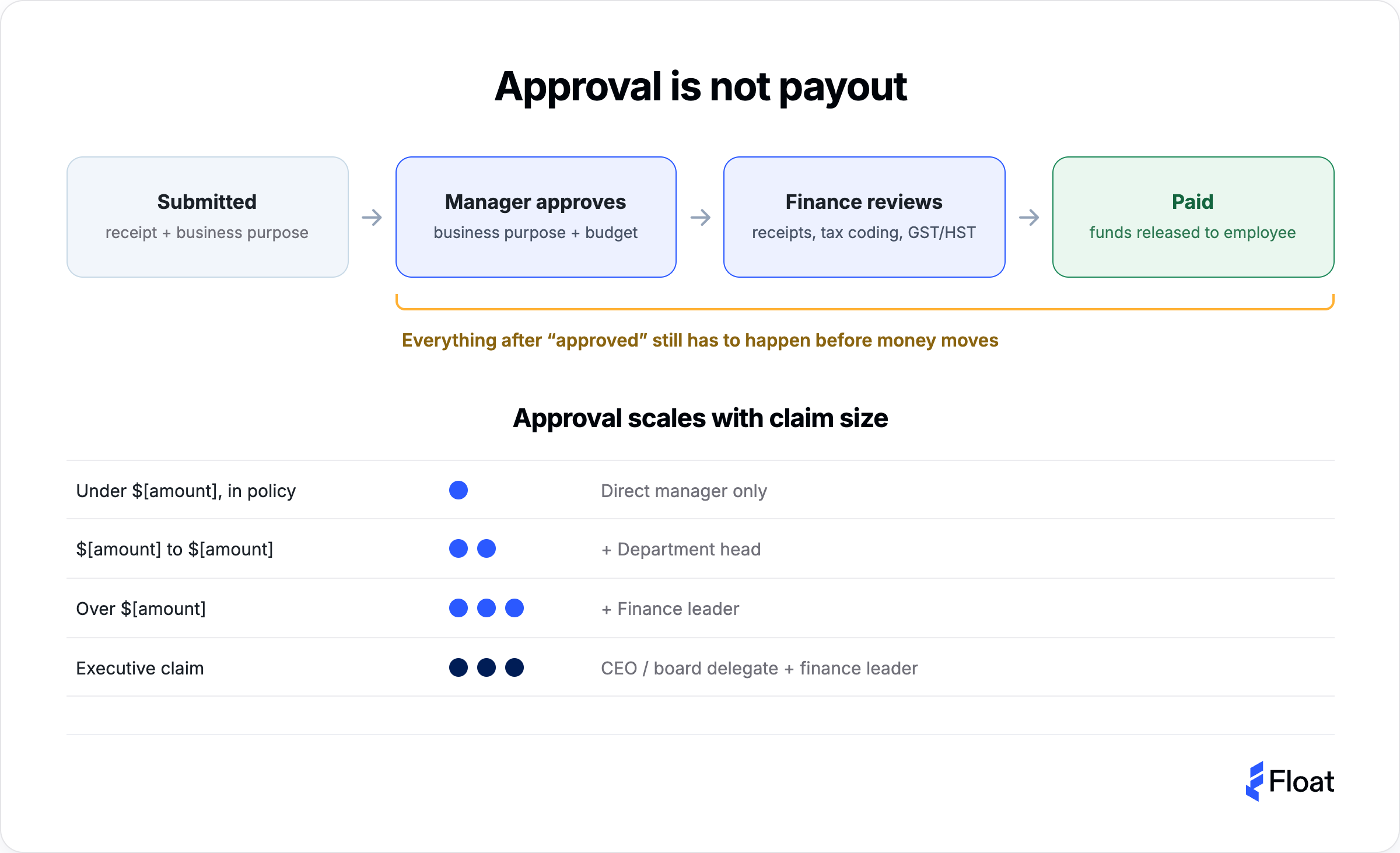
Approval chains should get stricter as the amount, category or tax risk increases. A $24 parking reimbursement should not move through the same chain as a $2,400 conference claim.
Set approval rules in tiers, such as:
What each approver checks
The policy should also name what approvers are approving:
- Managers confirm the business purpose and budget fit.
- Finance confirms documentation, tax coding, policy compliance and payout readiness.
That distinction prevents approval drift, where a manager approves a client meal because it was useful while finance later discovers the receipt is missing, the attendees are unnamed, or the tax code is wrong.
Approval is not payout
“Separating ‘approved’ from ‘paid’ sounds like a technicality until someone asks why their reimbursement hasn’t landed a week after their manager said yes. Approval means the business accepts the expense, while payout means finance has what it needs to actually release the money.” — Sean Lim, Controller at Float
In Float, reimbursement reports can move through custom approval workflows, and approved reports can then be reviewed and scheduled for payment. That separation is worth mirroring in the policy: approval means the business accepts the expense, while payout means finance has enough support to release funds.
USD spend needs one rate
USD expenses need a single, source-of-truth foreign exchange (FX) rule. Employees, card issuers, and accounting systems can all calculate different CAD equivalents for the same USD purchase. If the policy does not clearly define which rate to use, finance ends up reconciling mismatched totals and reviewing screenshots from personal cards, payment apps, and online currency converters.
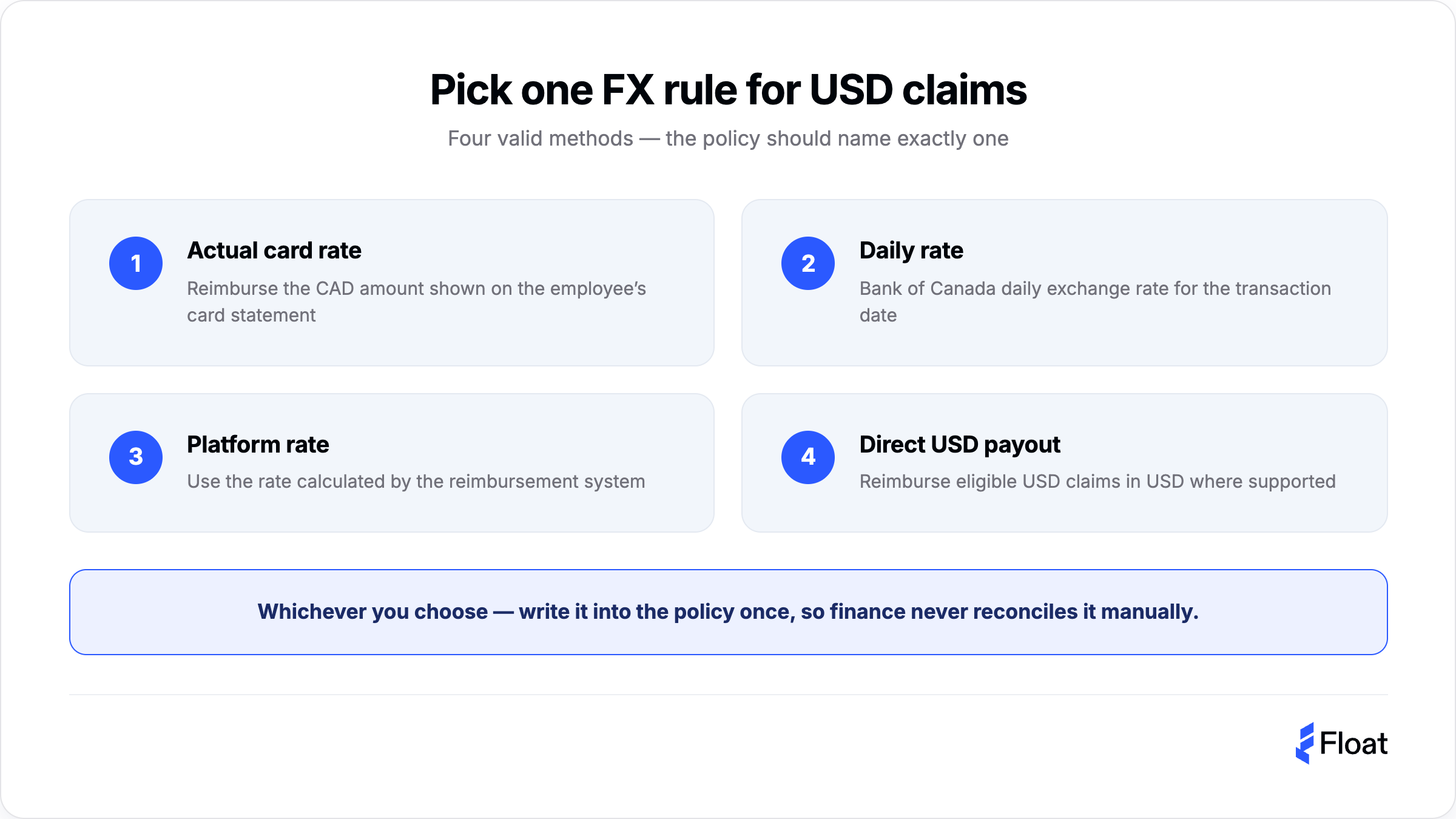
Use one of these methods and write it into your policy:
- Actual card rate: reimburse the CAD amount shown on the employee's personal card statement, with the statement attached.
- Daily rate: convert the foreign amount using the Bank of Canada daily exchange rate for the transaction date.
- Platform rate: use the rate calculated by the reimbursement system.
- Direct payout in USD: reimburse eligible USD claims in USD where the company supports it.
“Every USD claim without a defined FX rule turns into its own reconciliation project. Pick one rate, write it down, and month-end stops being a scavenger hunt for card statements and screenshots.” — Rita Bellavia, Financial Operations Manager at Float
CAD and USD payouts
If your policy allows USD reimbursement, add three clauses:
- Employees must submit the original currency and receipt.
- The company will not reimburse foreign transaction fees unless pre-approved or unavoidable for a business purpose.
- Non-CAD and non-USD expenses will be converted using $[exchange-rate source] and paid in $[currency].
That precision saves time at month-end because the accounting team can reconcile the report to the payout and exchange-rate source without reconstructing the decision later.
Quebec needs a French version
Employers with Quebec employees should treat the expense reimbursement policy as a workplace document that requires French-language review and, where required, publication in French when it relates to working conditions.
The Office québécois de la langue française lists workplace documents that include “documents ayant trait aux conditions de travail” among materials employers must draft in French. In practice, that covers documents about working conditions. An expense reimbursement policy usually fits because it sets the rules for how work-related costs are handled.
What to publish
If your finance team supports employees across Canada, the safest way to operate is to treat the French version as part of the policy, not a follow-up:
- Publish the English and French versions at the same time.
- Update the French version whenever the English version changes.
- Keep limits, approver titles, and submission deadlines identical in both.
- Provide French versions of forms, employee instructions, and training materials for Quebec-based employees.
- Ask Quebec counsel to review if the company has Quebec-based employees, an establishment in Quebec, or francization obligations.
Do not treat translation as an afterthought. If employees use the policy to decide whether to spend personal money for work, the French version needs to be available before the reimbursement cycle begins, not after the first exception.
Copy the expense reimbursement policy template
The fastest way to publish an expense reimbursement policy is to fill in the limits, approver names and payout timing before legal or payroll review. Use the template below as the working draft.
[Company name] expense reimbursement policy
Effective date: [Month day, year]
Policy owner: [Finance owner]
Applies to: [Employee groups and jurisdictions]
Review cadence: [Annual / semi-annual / other]
Purpose and scope
1. Purpose
[Company name] reimburses eligible employees for reasonable, approved business expenses they pay out of pocket while carrying out their work duties. This policy explains which expenses are reimbursable, what documentation is required, who approves claims and when payment is made.
2. Scope
This policy applies to [full-time employees / part-time employees / temporary employees / interns / contractors] who incur approved business expenses for [Company name]. It does not apply to supplier invoices, payroll items, personal expenses, relocation payments, cash advances or purchases that should be made through [procurement / bill pay / company card process].
Employees should use a company-approved payment method, including [Float corporate cards / procurement / bill pay], when available. Reimbursements are for approved out-of-pocket expenses only.
Expenses and exclusions
3. Reimbursable expenses
[Company name] reimburses the following categories when the expense is reasonable, business-related, properly documented and approved:
4. Non-reimbursable expenses
[Company name] will not reimburse:
- Personal purchases or entertainment.
- Commute costs between home and the regular workplace.
- Fines, penalties, traffic tickets or parking tickets.
- Unapproved travel upgrades, seat fees or lounge access.
- Alcohol unless pre-approved for a client or company event.
- Family, guest or companion costs unless pre-approved.
- Lost, damaged or stolen personal property.
- Expenses submitted after the deadline without an approved exception.
- Expenses without adequate business purpose or documentation.
Receipts and deadlines
5. Receipt and documentation rules
Employees must submit each reimbursement claim through [system name] within [number] days of the transaction date. Each claim must include:
- Receipt, invoice or digital confirmation.
- Supplier name.
- Transaction date.
- Amount and currency.
- GST/HST, PST or QST amount where shown.
- Business purpose.
- Attendees for client meals.
- Project, department, customer or GL code where required.
Card statements alone aren't sufficient unless finance approves an exception. If a receipt is lost, the employee must submit a lost receipt declaration with the supplier, date, amount, currency, business purpose and reason the receipt cannot be recovered. Finance can reject claims without adequate support.
6. Submission deadline
Employees must submit reimbursement claims within [number] days of the transaction date and no later than [number] business days after month-end. Claims submitted after [deadline] can be denied unless [approver] approves an exception.
Approvals
7. Approval workflow
Reimbursement claims follow this approval chain:
Employees cannot approve their own reimbursement claims. Managers approve the business purpose and budget fit, while finance reviews documentation, tax coding, policy compliance and payout readiness.
Currency and tax
8. CAD, USD and foreign currency
Claims must be submitted in the original transaction currency. CAD claims are reimbursed in CAD. USD claims are reimbursed in [CAD / USD] where supported by [Company name].
For non-CAD expenses, [Company name] uses [actual card statement rate / Bank of Canada daily rate / reimbursement system rate] for the transaction date. Foreign transaction fees are reimbursable only when [pre-approved / unavoidable for a business purpose].
9. Payout timing
Approved and finance-reviewed claims are paid within [number] business days, provided the employee's payment details are complete and the funding source has sufficient funds. Claims with missing receipts, missing payment details, policy exceptions or approval issues can take longer.
10. Tax treatment
[Company name] reviews reimbursements for Canadian tax treatment, including GST/HST input tax credit eligibility and taxable-benefit treatment. Because receipt-backed business expenses are handled differently from flat allowances or personal-use reimbursements, finance and payroll can adjust, deny or report amounts where required by applicable law.
Quebec and exceptions
11. Quebec employees
Where required, [Company name] will provide this policy, related forms and employee instructions in French for Quebec employees. The French version will be kept current with the English version.
12. Exceptions
Exceptions require written approval from [finance leader] before reimbursement. Approval of one exception does not change the policy or create approval for future claims.
Make reimbursement boring
The best reimbursement policy is not the one employees memorize. It’s the one where employees know whether an expense qualifies, managers know what they are approving, and finance knows the receipt, tax coding, and payout details are complete.
Float gives finance teams a workflow to support the policy they publish. Employees submit out-of-pocket expenses and mileage, approvers review them, and finance pays approved claims from the right balance. No more manual expense reports. No more spreadsheets.

Try Float for free
Business finance tools and software made by Canadians, for Canadian businesses.