Implementation Work Is Changing: Here's What We Automated at Float

In this article

Since we first launched our cards product, getting a complex customer live on Float meant people on calls, spreadsheets and weeks of back and forth. AI can now do much of that work, and here is our story on how we got there.
The shift: work we couldn't automate before
For years, software automated the tidy parts of a job: repeatable steps with clean inputs. The messy parts stayed with people, because they often meant reading a pile of documents, deciding what mattered and proposing a plan.
Large language models (LLMs) changed that. An LLM is trained on enormous amounts of information so it can read unstructured documents, pick out patterns and write back a structured answer. That is the shape of a lot of knowledge work, and customer implementation on our cards product was a clear opportunity to use AI to improve both our team's efficiency and our customer experience.
The problem: Our team had to scale with our growth
When a business moves its spend to Float, creating a card is quick. The hard part is the thinking behind it: which vendors get their own card, where the limits sit, what spend belongs together, which rules to pre-code and which policies to use.
For a long time, our implementation team answered those questions by hand. A migration looked like this:
- The team asked the customer for their card statements, which usually arrived in pieces.
- Someone cleaned them up and sorted recurring vendors from one-off purchases.
- They worked out a sensible card structure and built the cards.
- Questions went back and forth until the plan matched how the business really spends.
It worked, and customers who got this hands-on setup ramped their spend nearly twice as fast vs. those that didn't. But we usually gave our implementation teams 120 days to fully ramp a customer, and the process only scaled as far as the number of people we had.
So we built our own tools
The people closest to a workflow are the best positioned to automate it. They know where the time goes and what "good" looks like. Teams that wait for a vendor to build it for them will wait a long time.
The first pass was just file ingestion with categorization, but still required manual intervention to modify, code, and provision the cards. It helped, but it was still manual, because it only worked when one of us was owning it.
That's when it clicked for us: Every customer on Float should have access to this experience, but in a self-serve way. So we rebuilt it as part of Float and made it available to every new customer.
What we automated, and how it works
We first embarked to build our "golden dataset" as we called it. A few dozen examples where unstructured anonymized data was transformed into what the customer wanted. We also baked into the model what great card structures looked like, and spent nearly half our build time getting this part right. During this stage, we exposed the guts of this new tooling to our implementation team while they onboarded new customers, to sanity test the changes we were making. This accelerated our precision and accuracy. Each release also had the Implementation team themselves getting faster at this job.
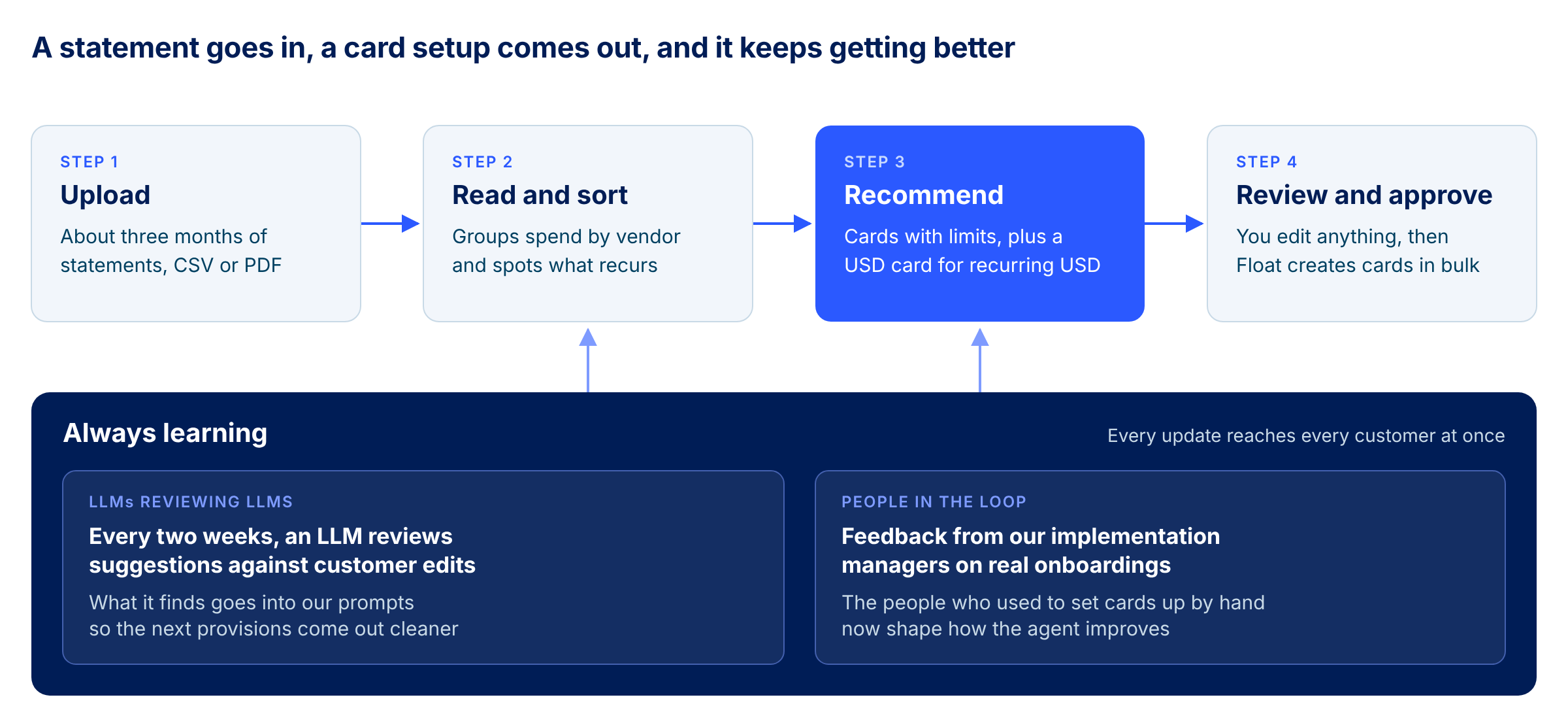
You upload statements and the agent reads them. It recommends cards and limits, you review and approve, and Float creates the cards in bulk.
Finally, we invested in building our version of the nightly dream cycles, where behind the scenes, we retrain the model every night on its own reasoning and on customer inputs, so it gets more accurate. This meant the model improved automatically every day, and each new skill reached every customer instantly, with no manual knowledge sharing or retraining.
By the time we launched this feature for all customers, we had a polished experience that created a seamless moment to review, add, modify, and ultimately provision your business's cards in mere minutes. We also added primers, helpers, and guided prompts to keep users moving through the flow.

The evidence: onboarding got faster, and our teams scaled with it
The biggest impact was implementation time. At Float we have a promise, that you can get started and fully migrate off your legacy cards or expense solution in <30 days.
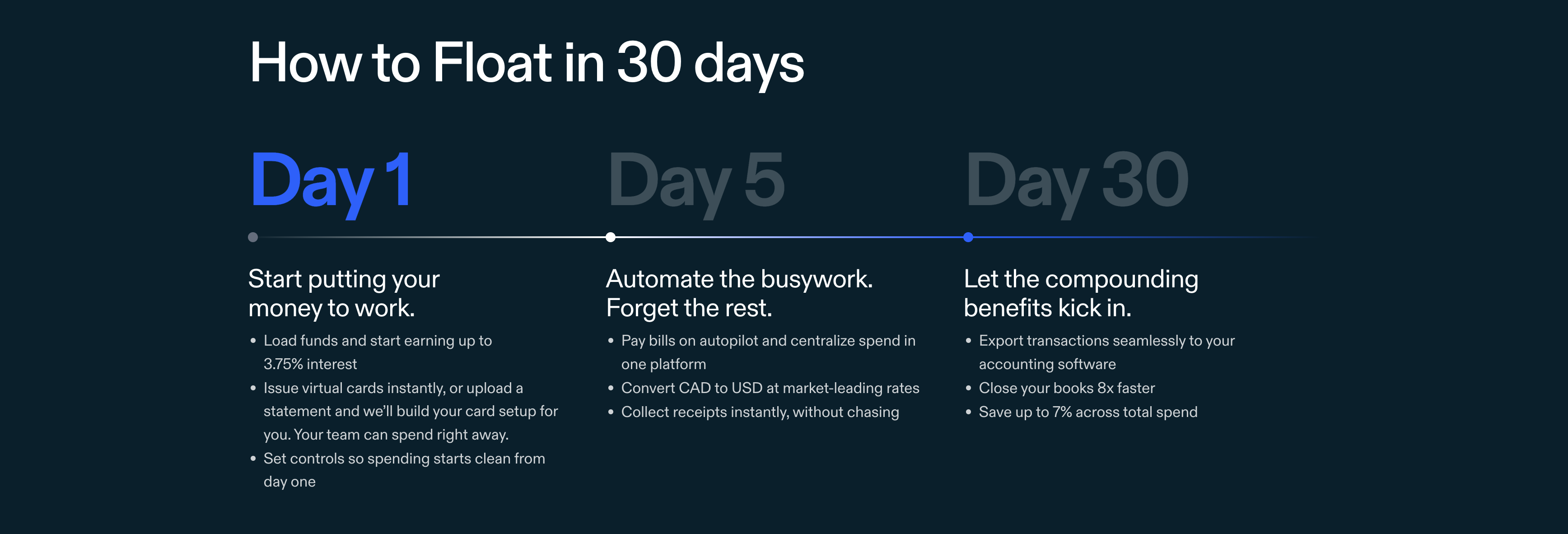
Time it took to onboard cards was cut almost in half, alongside other changes to our process. That gave our teams room to help customers onboard onto new products.
The effect shows up in what customers adopt next. Our newest managed customers have the highest multi-product attach rate we've ever seen, nearly double that of our existing base. Momentum builds momentum.
- 51% of all new signups are using the Onboarding Agent, and that number jumps to almost 80% for those that verify their business and begin spending.
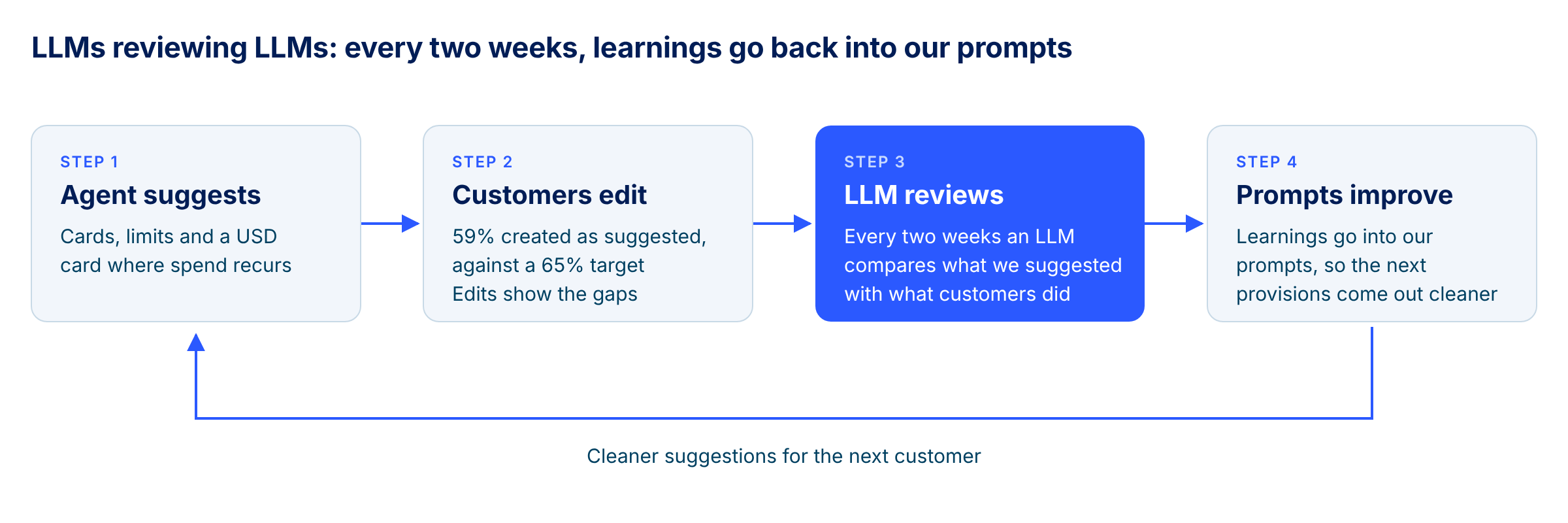
- The Onboarding Agent after only being live 1 month has a provisioning rate of 59%. These are cards that remained untouched by our suggestions. Our target was 65% as we encourage customers to modify the cards to make them their own, but don't want them putting in too much work to get there.
- We estimate ~2 weeks of onboarding time has been saved per managed customer, allowing our implementation team to accelerate onboarding into new products. It also means our team can manage a larger book as well, with all these manual steps removed.
What we learned, including what didn't work
The hardest part wasn't getting a model to read statements. It was getting it to produce a setup that a finance person would trust as their own. We wanted to encode the years of experience our activations teams had into a repeatable playbook that an LLM could execute at scale.
A technical challenge: making it feel human. Every customer's statements look different, and we only recommend a card when the agent can read a real vendor name and recurring spend. It also had to be smart enough to know that an airline charge isn't generic spend; that's likely travel for a specific cardholder the customer needed to add. Early on, our engineers also noticed the model suggesting oddly specific limits. Real people set a limit of $7,000, not $7,150. We taught the model to round the way a person would, and the recommendations started to read like a setup someone had chosen.
What we've seen since launch:
- Most suggested cards were created exactly as proposed, which tells us people trust the recommendations.
- When people did edit, they usually raised the limit. Our suggestions lean cautious, and we're tuning that.
- More suggestions weren't better. Past a certain point, customers stopped finishing. The hardest thing is to get AI to say less. We're testing ways to show the most useful cards first.
Every two weeks, we now use an LLM to review the agent's suggestions against what customers changed, then fold what it finds into our prompts so the next provisions come out cleaner. LLMs reviewing LLMs is a strong model for anyone building AI tools to adopt.
It's early, and we're still learning from every onboarding.
What it means for roles and teams
When the agent took over statement reading and setup, our implementation work didn't disappear. It moved. Our Implementation team now spends their time on higher-leverage work, like in-person team training, which no AI can do for a customer.
That is the pattern we expect everywhere, which is also why we believe that AI will lead to companies hiring more, not less. AI is best at the work people never wanted: reading, sorting, assembling and checking. It was never about cost cutting, it's about growing faster. Humans are best at judgment, trust, and teaching. A team that hands the first kind to software can spend more of its week on the second.
Setting up cards is only one tiny slice of onboarding. The same approach, where the agent reads what a customer already has, proposes a setup and a person approves it, applies well beyond cards. We are already applying this in many parts of our product.
Our bet is that the companies that apply AI to their own operations first won't just move faster. They'll define what these jobs look like next.

Try Float for free
Business finance tools and software made by Canadians, for Canadian businesses.