Automating Conference Expense Management for a Smoother Workflow

Business conferences and trade shows are more than just name tags and networking—they’re strategic investments. These events offer teams the chance to build a sales pipeline, deepen client relationships, gather market insights and boost brand awareness. But let’s face it: they’re also expensive.

Spending can escalate quickly between flights, hotels, ground transport, meals, client entertainment, and pre-event costs like sponsorships and swag. Finance leaders are now expected not just to fund these trips, but to ensure they run smoothly, stay within budget and avoid a post-trip reconciliation scramble.

That means finance teams aren’t just approving card limits from the sidelines. Rather, they’re enabling organized, efficient, and cost-effective travel. As conference attendance increases, scaling this process with the right tools becomes critical.

In this guide to automating conference expense management, we’ll explore how finance teams can empower employees to spend confidently, how they can prepare smartly for business travel and how Float can help.

Finance’s role in seamless event travel

Gone are the days when finance simply reimbursed expenses weeks after a trip. Or to explain, yet again, why taking a limo from the airport is not in the expense policy. Today’s most effective finance teams act as strategic partners, setting the stage for controlled, confident travel.

Today’s most effective finance teams act as strategic partners, setting the stage for controlled, confident travel.

When done right, finance empowers employees by providing:

  • Real-time virtual and physical cards issued by spend category, employee or department
  • Fast, mobile-friendly pre-approvals before anyone departs
  • Policy-aligned guardrails that reduce guesswork and limit out-of-scope spending

This approach helps employees understand what they can spend, when and how, without needing to pay out-of-pocket or upload crumpled receipts at the end of a long day. It also gives finance teams peace of mind knowing the rules are clear and spend is tracked from the start.

When manual expense processes don’t bog down employees, they can focus on their purpose at the event: connecting with prospects, deepening client relationships and representing the company brand.

What finance should know before takeoff

Strong execution starts with smart planning, and finance plays a key role in making that happen. Before your sales or marketing team books a flight, finance leaders should work with them to anticipate spending and map out a plan that balances flexibility and control.

Here’s how to prepare your team for success:

  • Forecast common expense categories
    Build a list of expected costs such as conference registration, transportation, meals, hotel stays, incidentals and client entertainment.
  • Set flexible budgets by role or team
    A little structure helps avoid overspending. Budgets can be tailored by individual, department or trip type.
  • Plan for the unexpected
    Travel is rarely without surprises—plan for delayed flights, extra hotel nights or unexpected client dinners.
  • Account for local logistics
    Include regional factors like tipping customs, weather conditions and travel norms. These seemingly small items can have a noticeable impact on spending.

By leading this planning process, finance can ensure employees are empowered, not reactive, and that no one is blindsided by unexpected costs.

Win the week with Float

Float is built to simplify business travel for everyone—whether you’re sending one person to a small meetup or your entire team to a major industry event.

Here’s how Float helps before, during and after the event:

  • Assign budgets by employee, team or category
    Know how much is being allocated and for what purpose before the first receipt rolls in.
  • Issue virtual and physical cards with adjustable limits
    Float cards can be loaded with specific budgets for meals, ground transport or client entertaining. These limits can also be adjusted as needed.
  • Manage approvals and monitor spend in real time
    Use Slack or mobile to approve requests, keep tabs on active spend and resolve issues before they escalate.
  • Automate receipt capture and reconciliation
    Float eliminates the need for manual entry by collecting, categorizing and matching receipts as soon as a transaction happens. That means employees (and finance pros) don’t have to dread the post-event expense report process.

These tools reduce administrative overhead, lower the risk of error, and allow finance teams to support fast-paced travel while maintaining full visibility and control.

Float helps you better manage
your business spend

See how with your personalized
demo from a Float expert.

Travel smarter, reconcile faster

When employees travel for work, time matters for them and you. Giving your team the right tools helps them focus on building relationships, closing deals and bringing back value. No more worrying about how to track a taxi ride or submit a lunch receipt (and no more worrying from your finance team as they wait to see if the team has gone entirely over budget).

Float enables finance leaders to:

  • Prevent overspend with clear, proactive guardrails
  • Empower employees with quick access to funds
  • Remove post-trip reconciliation bottlenecks
  • Maintain visibility and control from start to finish

With Float, finance teams can be proactive partners—not reactive gatekeepers. Whether you’re preparing for a local conference or a global trade show, Float gives your team the foundation to operate smoothly, with fewer manual processes and more real-time insight.

A successful business trip shouldn’t come at the cost of your finance team’s sanity. With the right systems in place, expense management doesn’t have to be a burden—it can be a strategic advantage.

Discover how Float helps finance teams simplify event travel from pre-approval to post-trip reconciliation.

The Ultimate Guide to Business Banking for Canadian Companies

Running a business in Canada means juggling a lot of moving parts—and your banking setup can either make things easier or more complicated. With over 98% of Canadian businesses falling into the small or medium-sized category, most business owners are dealing with the same challenges: managing cash flow, paying bills, tracking expenses—and doing it all without getting buried in spreadsheets.

The problem?

A lot of banking tools out there still feel stuck in the past. But the right business banking partner or business finance solution can flip the script—helping you ditch the clunky processes and grow your business with smarter, faster tools that work with you, not against you.

This guide will walk you through modern business banking in Canada, including what today’s fintech solutions offer, how they differ from traditional banks, and the key questions to ask when weighing your options between a traditional bank and a more modern business finance solution.

Why business banking matters for Canadian companies

So, why does business banking matter so much?

Sure, the obvious answer is that you need a place to keep your cash—no money, no growth. But there’s more to it than just having a safe spot to stash your funds.

Choosing the best business banking setup can actually shape your company’s financial foundation. It helps you separate business and personal finances (which is more important than many think), build your business credit, and influence how clients, partners, and investors perceive your professionalism and stability.

The main advantages are:

  • Accurate tracking of income and expenses
  • Simplified tax filing and audits
  • Easier access to business credit and funding opportunities
  • Protection of personal assets from business debts

What makes a business bank account “best” for you?

The ideal business bank account is one that aligns with your company’s specific needs, considering its scale, the volume of transactions it handles, and its future growth objectives.

  • Low or transparent fees
  • Digital banking tools
  • High-yield savings options
  • Integration with accounting software
  • Flexible payment and card solutions

High-yield business accounts in Canada: What to look for

When looking at business banking solutions or  a modern business finance solution, you want to make sure that you’re exploring high-yield business accounts. 

Most typical business bank accounts don’t give you much in the way of interest, but there are special high-yield accounts that can actually help your business’ cash grow. 

A high-yield business account helps your money work harder by earning interest on idle cash, boosting your returns without extra effort. And depending on your financial provider, you could see interest rates as high as 4% on business balances..

How do high-yield accounts work?

High-yield business accounts allow your company to earn interest on its cash balances, generating passive income on funds that are not immediately needed. These accounts offer significant advantages for various types of businesses, like:

  • Service-based businesses (like agencies or consultants) can earn interest on retainers or prepaid contracts before using the funds for payroll or expenses.
  • Ecommerce stores can grow idle cash between sales cycles or before big inventory purchases like Black Friday.
  • Property managers benefit from earning interest on rent collections held for future maintenance, taxes or distributions.
  • Bootstrapped startups and nonprofits can stretch their runway or funding by earning passive returns on reserve cash.

Here are some factors you want to evaluate with your high-yield savings accounts: 

  • Understand the annual percentage yield (APY) to know the actual return on your deposits.
  • Be aware of any minimum balance requirements that might apply.
  • Assess the ease with which you can access your funds when needed (liquidity).
  • Consider how well the account integrates with your other banking services.

Float’s high-yield account provides up to 4% interest, transparent terms without hidden fees, and no lock-ups.

Corporate cards: no personal guarantee, high limits and spend control

Another key when it comes to your business banking or finance solutions? Corporate cards. 

Corporate cards can be a game-changer for business owners. They usually come with higher limits, smart controls and no personal guarantees, so you’re not putting your own credit or assets on the line. 

And the modern options come with some other major perks.

Traditional cards often demand a personal guarantee, which can expose your personal finances. Thankfully, new options provide high credit limits without this requirement, offering business owners greater adaptability and peace of mind.

Key benefits of corporate cards include:

  • No personal guarantee required
  • High spending limits tailored to business needs
  • Real-time spend controls and customizable limits
  • Automated receipt capture and expense categorization

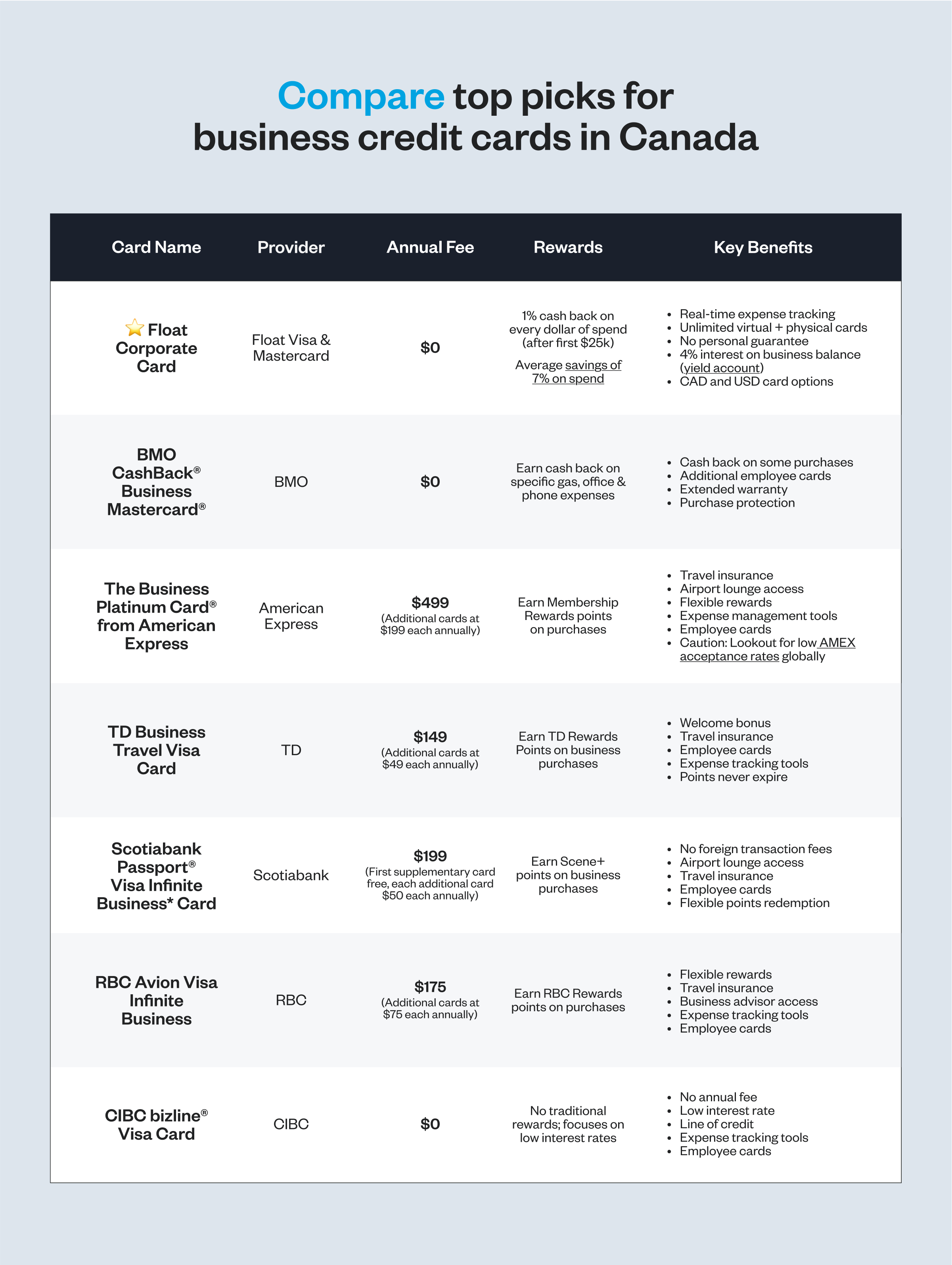
It’s important to weigh the different pros and cons of different corporate cards to ensure you’re getting what you need. Check out the handy comparison below for some of the best business credit cards in Canada: 

Comparison chart of top business credit cards in Canada featuring Float, BMO, American Express, TD, Scotiabank, RBC, and CIBC. Highlights include annual fees, cashback or rewards programs, and key business benefits like expense tracking, travel insurance, low interest rates, and employee cards. The Float Corporate Card stands out with no annual fee, 1% cashback, and 4% yield on balances.

Expense management software: Automate, integrate and save time

If a high-yield savings account helps your money grow in the background, automated expense tracking helps you save time and sanity upfront.

Manual expense tracking is a drain on time and opens the door to mistakes. Switching to automated expense management software can lighten your administrative load and boost accuracy. A modern expense management platform lets you: 

  • Snap and store receipts effortlessly with your phone or email.
  • Keep a constant eye on your transactions in real time.
  • Seamlessly connect with your accounting software, like QuickBooks or Xero.
  • Set up customized approval steps that fit your team.
  • Gain clear insights into your spending with detailed analytics.

So how does automated expense management software actually work?

Automated expense management software simplifies what used to be a manual, time-consuming process—by handling each stage of expense tracking for you. Here’s how it works in practice:

  • Capture: The software automatically collects receipts and transaction data from various sources—credit card feeds, email, mobile uploads—so nothing slips through the cracks.
  • Categorize: Once captured, expenses are instantly sorted into the correct categories, accounts, or project codes based on your pre-set rules.
  • Approve: Submissions are routed through custom approval workflows, ensuring the right people review the right expenses—without back-and-forth emails.
  • Reconcile: Finally, approved expenses sync directly with your accounting system, keeping your books up to date and audit-ready with minimal manual input.

Companies that have adopted automated expense management have seen real benefits. Some companies have seen upwards of 76% time back on their accounting processes—imagine what you could be doing with that kind of time! 

Bill payment automation and accounts payable solutions

Once your internal spending is under control, the next big win is handling what goes out the door. Paying suppliers shouldn’t mean chasing emails or getting lost in spreadsheets—and yet, that’s the reality for a lot of businesses.

Paying your suppliers on time is crucial for any Canadian business. But let’s be real. Chasing down invoices and juggling manual payments can be a major time suck. It’s tedious, prone to errors, and not the best use of your team’s energy. 

Thankfully, there’s a smarter way. Automating your bill payments lets you schedule and approve payments from anywhere online. This helps you avoid those annoying late fees, avoid duplicate payments and keep a trackable record of all your transactions without the stress.

Here’s how solutions like Float can help with bill payment automation:

  • See all your invoices and schedule payments in one simple place.
  • Set up customized approval steps to match your company’s needs.
  • Connect directly with your accounting software to keep everything in sync.
  • Know exactly where your payments are with real-time tracking.

Learn more about Float

Get a 10-minute guided tour through our platform.

Choosing the right business banking solution: What to consider

Now that you know everything your business banking or business finance solution can get for your business, it’s time to start shopping. 

When you’re checking out different business banking and expense management options, ask yourself: 

  • What are the fees for accounts and transactions?
  • How much interest can you earn on your deposits?
  • What kind of card features and spending limits do they offer?
  • Will it work with the tools you’re already using?
  • How helpful and quick is their customer support?

The answers will reveal your business banking needs, helping you find the right solution. 

What Makes Float Different?

One popular solution for Canadian businesses is Float. With Float, you can: 

  • Earn up to 4% interest on your business account.
  • Get corporate cards with high spending power without a personal guarantee.
  • Say goodbye to manual expense tracking with automation and easy receipt capture.
  • Connect smoothly with QuickBooks and other accounting software.
  • Enjoy transparent and honest pricing with no surprises.

Float eliminates the busywork, lowers risks, and equips Canadian businesses with the tools they need to expand effectively.

“Because of Float, we’re all free to focus on data-driven, value-added work that grows our business and supports our customers.”

Eddison Ng, Co-Founder, Coastal Reign

Business finance solutions that works for you

Canadian businesses need more than just a basic place to keep their money. The ideal banking or finance solution fuels growth, improves cash flow and cuts down on annoying administrative tasks. They need a solution that work with them.

Float is a complete business finance platform that offers high-yield accounts, modern corporate cards and automated expense management—all built with Canadian businesses in mind.

Ready to see how Float can save your company time and money? Book a demo today

Automated Bill Payments for Businesses: Smart Solutions for Canadian Businesses

Keeping on top of bill payments is no small feat for growing Canadian businesses. Between due dates, approvals and surprise invoices, it’s easy for things to slip through the cracks if you’re doing everything manually. Old school processes chew up valuable time, increase the risk of errors and can even damage relationships if something slips through the cracks.

That’s why more and more companies are turning to automation. Automating bill payments for businesses can be a game-changer for Canadian companies looking to save time, reduce errors, and avoid chasing paper trails.

This guide will discuss the right tools to help you free up hours each month, keep payments flowing smoothly, and protect your cash flow.

Why it’s time to rethink manual bill payments

If you’re still paying bills manually, you probably know the drill: endless paperwork, tedious data entry, chasing down approvals and too many chances for something to go wrong. One late payment can trigger fees, hurt supplier trust and throw off your cash flow forecast.

It’s a lot of hassle and only worsens as your business scales.

Enter automation. With modern payment automation, you can:

  • Save time by eliminating repetitive tasks (Some businesses with automated payments and intelligent business banking solutions have been able to reduce up to 96% of their repetitive bookkeeping tasks)
  • Cut down on errors (no more fat-fingered numbers or missed due dates)
  • Improve cash flow by letting you schedule payments and avoid late fees

Bottom line? You’ll spend less time on admin and more time growing your business.

Try Float for free

Business finance tools and software made

by Canadians, for Canadian Businesses.

How automation works behind the scenes

So, how does all this automation work?

It’s not just magic (though it can feel like it). Behind the scenes, a mix of smart tech tools is quietly doing the heavy lifting—scanning invoices, pulling out the details, routing approvals and making sure payments go out on time. 

Let’s examine some of the key technologies making it all happen and how they’re helping Canadian businesses eliminate unnecessary busywork.

  • Optical Character Recognition (OCR): OCR tech scans invoices and receipts, then pulls out important details like amounts, due dates, and vendor names, so you can upload receipts without having to type every detail. Say goodbye to accidental errors!
  • Machine Learning (ML): ML helps systems “learn” how your business pays bills over time. It can recognize patterns in vendor payments, suggest codes, flag suspicious activity or even predict cash flow needs—all based on your historical data.
  • Electronic Payment Platforms: Instead of cutting cheques or manually entering banking details, Electronic Payment Platforms handle electronic payments directly to your vendors. You can also set up recurring payments and track everything in one place.

Setting your business up for success

Choosing the right payment solution can significantly affect how smoothly your business runs. Below, we’ve rounded up a few key things to consider before diving in.

What to look for in a solution

When picking a bill payment platform, keep these things in mind:

  • Easy integration with your accounting and expense management software
  • Top-notch security that complies with Canadian financial standards
  • Scalability to support your business as it grows
  • User-friendly interface for quick adoption across your team
  • Automated approval workflows to reduce manual tasks and errors
  • Flexible payment options (e.g., EFT, credit, ACH) to suit vendor preferences

Getting started

  1. Map out your current process to spot pain points.
  2. Select a platform that covers your needs today and down the road.
  3. Train your team so everyone’s up to speed and confident using the new system.

Pro tip: Don’t try to automate everything on day one. Start small and expand as you go.

How Float helps Canadian businesses automate payments

Float isn’t just a corporate card provider. We offer a fully integrated solution for smarter spending, including bill payment automation.

Here are some reasons that finance teams across Canada count on Float to help them automate payments (among other things):

  • Auto-capture receipts and transactions: Float automatically grabs receipts and matches them to the right accounts, reducing manual entry.
  • Syncs with your accounting software: Easily integrate with QuickBooks, Xero and NetSuite—no manual imports needed.
  • Real-time spending insights: Get instant visibility into spending and generate reports on demand, with alerts for unusual activity.
  • Customizable approval workflows: Set up approval processes that fit your business needs, making approvals faster and easier.
  • Streamlined accounting hub: Float helps accountants quickly review, automate and export transactions for smooth month-end closes.

Final thoughts

Bill payment automation isn’t just a nice-to-have anymore—it’s a competitive edge to help you do more with less. Whether you’re a lean startup or a fast-growing team, automating how you pay your bills can save time, reduce errors and keep your cash flow running smoothly.

And with platforms like Float, you can connect bill payments directly into your broader spend management strategy so everything works together not in silos.

Want to see how Float can help? Take a tour today.

Best Practices for Ensuring Expense Policy Compliance 

A clear, well-communicated expense policy is the unsung hero of smooth financial operations. It’s also essential for protecting your business. Without consistent expense policy compliance, you’re left vulnerable to confusion and avoidable errors that stack up faster than those unclaimed receipts.

Melissa Lenos, the sole owner of King Business Solutions, has seen this firsthand. As a Certified Professional Bookkeeper (CPB) and Payroll Compliance Practitioner (PCP), she works closely with small and mid-sized businesses to streamline bookkeeping, payroll and expense workflows. 

“The most common reason employees fail to follow policies is simple,” says Melissa. “They don’t understand them. Or worse, there is no clear policy in place.”

In this article, Melissa shares her proven strategies to help business owners tighten expense policies without the typical drama and detective work.

The importance of expense policy compliance

A strong expense policy protects the books while also protecting your people. When everyone understands the rules and has the tools to follow them, you cut down on back-and-forth. It also enables you to build a team that spends responsibly without second-guessing every coffee run.  

Without proper guardrails, businesses face the risk of:

  • Non-reimbursable or non-compliant spending
  • Missed documentation leading to audit issues
  • Internal frustration or resentment from repeated errors

“It often starts at onboarding,” says Melissa. “If someone doesn’t know the expectations from day one, you’ll be chasing receipts, correcting reports and cleaning up the mess later.”

A clear, accessible expense policy sends a powerful message: We trust you to spend company money, but here’s exactly how to do it. 

How to develop a clear and comprehensive expense policy

Building a strong expense policy isn’t just about saying no to steak lunches or late-night limo rides. It’s about giving your team a roadmap they can follow. The best policies are clear, consistent and easy to reference. 

Key components of an effective expense policy

A good policy will outline expectations and proper practices and give employees clear direction on how to work freely within the policy. When employees know what’s expected, they’re more likely to get it right the first time. 

Here’s what Melissa says every policy should include:

  1. Clear definitions of reimbursable expenses

Spell out what qualifies as a business expense. Be specific about what’s covered, like client meals, mileage or software subscriptions—and what’s not.

  1. Specific rules around timing and submission

Set a deadline for expense submissions to avoid last-minute scrambles and stale receipts. This keeps your month-end close clean and your finance team sane.

  1. Restrictions based on category, place or time

Set boundaries to avoid awkward reimbursements. You may consider excluding expenses from specific venues or during non-business hours.

  1. Expectations for supporting documentation

Not all receipts are created equal. Make clear what proof you need, such as itemized receipts instead of just the credit card slip.

“Examples go a long way in creating understanding,” says Melissa. “Show people what an acceptable receipt looks like. Provide a template expense report for them to follow.”

She also recommends reviewing policies regularly to keep up with shifting business needs.

Use tools that make policies easy to follow

Even a well-written policy can fail if the systems behind it create friction. Over half of small businesses in Canada use financial tools that don’t integrate well with each other or are clunky and unintuitive.

According to Melissa, the right digital expense tools dramatically improve compliance.

“If you’re still chasing receipts through inboxes or glove compartments, you’re wasting valuable time.”

She often recommends Float to her clients, especially nonprofits, remote teams or businesses with evolving structures. 

With Float, businesses can:

  • Issue physical or virtual cards with spending limits
  • Automatically prompt users for receipts
  • Restrict spending by merchant, time, or category
  • Pause or revoke access after repeated non-compliance

“It automates the nagging,” says Melissa. “Instead of awkward reminders, the system enforces the rules for you.”

Make expense management even easier

Streamline your business spending with automation tools built right into Float.

Communicating your expense policy

Even the most thoughtful policy won’t make a difference if it’s buried on page 47 of a handbook or explained in accountant-speak. Expense policy compliance starts with communication—and no, a single onboarding meeting doesn’t cut it.

Let’s look at how to share your policy in a way that sticks, helps employees do the right thing and saves your finance team from becoming the office expense therapist.

Educate employees about expense guidelines

Even the best policy is useless if no one knows where to find it or how to use it. Melissa emphasizes the importance of integrating expense training into onboarding and beyond.

“Have your finance team walk new hires through the policy. And if someone makes a mistake, don’t just fix it quietly,” says Melissa. “Use it as a teaching moment.”

Use straightforward language and real-world examples

Jargon or legalese can quickly lose employees. “Policies should be easy to understand,” says Melissa. 

She recommends:

  • Keeping the language clear and concise
  • Using specific examples like “Submit itemized receipts, not debit slips.”
  • Highlighting exceptions and consequences in plain terms

Make policies accessible

Don’t bury the expense policy inside an employee manual that is reviewed at hiring and never looked at again. Attach it to the reimbursement form, pin it in your expense software or link it in your onboarding portal. Whatever your format, make sure employees can find it quickly.

Provide ongoing review and communicate consequences

Over time, employees will forget, habits will slip and processes will evolve. That’s why ongoing review and reinforcement are key.

“Some clients ask employees to sign a policy stating that if a receipt is missing, payroll can deduct the amount from an employee’s paycheque,” says Melissa. “That may sound tough, but it underscores how serious the expectation is.”

Melissa recommends having clear consequences for non-compliance and balancing fairness with accountability. It’s okay to let technology do the heavy lifting. 

“If someone isn’t following the rules with a card, switch them to a reimbursement model with stricter checks,” she says. “Let the system reinforce what needs to happen.”

Float: A solution built to support clarity and trust

Expense policy compliance doesn’t have to feel like breathing down everyone’s neck. With clear expectations and the right tools, it becomes a team sport instead of a game of gotcha. 

That’s where Float comes in. As a modern expense management platform built for Canadian businesses, Float gives finance teams real-time visibility, automated receipt capture and customizable spending controls that keep policies front and centre.

When policies are clear and the tech does the legwork, compliance can become a natural part of your business process instead of a monthly battle.

Top 6 Reimbursement Solutions for Canadian Companies

We live in a technological age, but not every part of business has caught up—especially reimbursement solutions. This area can quietly drain your team’s time, money and resources because it’s often handled manually.

You’ll end up with error-prone spreadsheets that waste your team’s time to review, delay your month-end close and ultimately lead to inaccurate financial forecasting. Sounds like a good time, right? Nope!

But reimbursement doesn’t have to be like that. A modern reimbursement solution isn’t just for collecting and organizing receipts anymore. It’s a critical part of operational efficiency, financial control and expense management. However, not all financial management software offers the same capabilities for expense tracking.

This article will highlight key considerations for Canadian businesses looking to automate expenses and share the top six reimbursement solutions.

Understanding expense reimbursement solutions

What are reimbursement solutions?

Reimbursement solutions are a key component of expense management software. These tools help businesses track, manage and reimburse employees’ out-of-pocket expenses while reducing the time spent on manual data entry and paperwork. They improve accuracy, speed up reimbursements and help finance teams run more efficiently.

How expense tracking software simplifies accounting

Modern expense tracking software streamlines the entire expense cycle, providing complete visibility into each stage:

  • Tracking: Monitor when an expense was submitted, approved and paid
  • Submission: Capture and organize receipts and expense details 
  • Approval: Identify who approved an expense and where delays occur
  • Payment: Track when reimbursements are issued

This visibility improves communication, reduces errors, and strengthens business expense controls across your organization. It also frees up your finance team to spend less time chasing receipts and more time on higher-value tasks (because no one went into finance to become a professional receipt detective).

Features and key considerations when choosing expense management solutions

When evaluating expense tracking software in Canada, prioritize more than just basic tracking. Look for solutions that offer:

1. Mobile receipt capture 

Receipts are fragile and easily lost. Mobile capture allows employees to submit, track and manage expenses directly from their smartphones, while automated workflows ensure approvals move smoothly without bottlenecks. A good mobile-first experience can drive higher adoption and eliminate friction for your team, helping you stay compliant with your expense reporting policy.

Make expense management even easier

Streamline your business spending with automation tools built right into Float.

2. Accounting integrations

Great financial management software integrates with popular accounting tools like QuickBooks and Xero, automatically syncing expense data to reduce manual entry and errors. This keeps your financial records accurate and streamlines your month-end close. Fewer manual touchpoints also mean less risk of human error, which is crucial for auditability and compliance.

3. Scalability and ease of use

Your financial management software should evolve as your business grows. If it can’t scale with you, you may face costly and disruptive migrations later.

Ease of use is just as important—who wants to use a platform that feels impossible to navigate? If the platform is confusing, adoption rates will suffer and you risk wasting your investment. Look for an intuitive interface that supports quick employee onboarding and enables self-service for basic tasks.

4. Security, data privacy and customer support

Expense management software handles sensitive financial data. Prioritize solutions that offer strong encryption, comply with Canadian privacy standards and provide responsive customer support. It’s essential to be able to get help quickly if you run into any issues. 

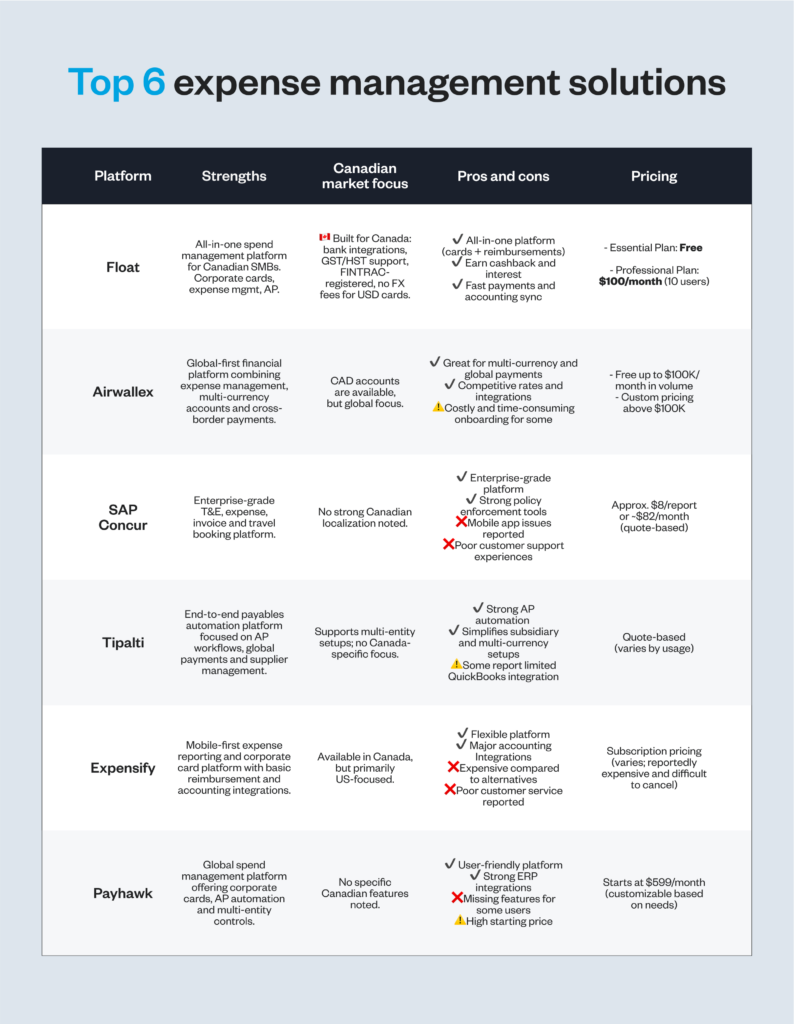
Top 6 expense management solutions

Choosing a modern reimbursement solution is a smart move. As an SMB, finding the best expense tracker for your business can also streamline your processes and boost team morale. But with so many options on the market, each with different features, pricing, and market focus, it’s crucial to find the right fit, especially for Canadian businesses.

Here’s a comparison to help you navigate the top choices:

Moving forward with the right tools

Manual expense reports are inefficient and costly. Adopting the right expense management solution can save your business valuable time, reduce human error and strengthen your overall financial controls.

While reimbursements are an important part of employee expense management, they should ideally be the exception—not the norm. For ultimate visibility and better control, the majority of spending should flow through corporate cards that are centrally managed by the finance team. Then, reimbursements are best reserved for occasional, unavoidable out-of-pocket expenses. Your expense management solution should seamlessly support both corporate card transactions and reimbursements within a unified workflow.

Canadian companies looking to modernize should choose software that supports scalability, easy integration, intuitive use, and strong security—now and for future growth. Float is a smart choice for those ready to move beyond manual processes. Designed for Canadian businesses, it unifies employee reimbursements, corporate cards, and real-time accounting in one powerful platform. Book a demo today!

How Do You Reconcile Corporate Card Statements Efficiently?​

Credit card reconciliation feels deceptively simple—until it isn’t. Most business owners and finance leaders know expenses should match what’s in the books, but that’s not always true.

Corporate credit card reconciliation can be particularly tough for small-to-medium-sized businesses and startups, where processes aren’t always clearly defined. But it doesn’t have to be that way.

Wondering how to do credit card reconciliation without giving you or your finance team a headache? In this article, we’ll answer all your most pressing questions around this topic, with industry expertise from Erika Dowell, CEO of Signal Operations, a Canadian bookkeeping and accounting company.

What is credit card reconciliation?

Simply put, credit card reconciliation is “a matter of taking the bank statement and matching it to your accounting files or bookkeeping files,” says Dowell. “The point of reconciling is to make sure that what the credit card company says you’ve spent is the same as what you’ve recorded in your books.”

Why does credit card reconciliation matter?

Reconciling your corporate cards is essential if you want to maintain:

Control over your cash flow

Credit card reconciliation lets you monitor your corporate spending and identify alarming trends before they escalate. 

Oversight of corporate expenses

It’s easier to prevent employees from exceeding travel limits or submitting personal restaurant receipts when you’re on top of what’s being spent. This oversight also means you’ll catch credit issues before you sink hundreds into something—think charges for outdated software and subscriptions that should have been cancelled after a trial.

Audit readiness

Staying on top of reconciliation also keeps you ready for any surprise audits. “The biggest mistake I see in credit card reconciliation is that people think the source document is the bank statement,” says Dowell. “But the CRA could look at a meal expense and deem it a personal expense if you don’t have the itemized receipt to support it.”

How to prevent operational blind spots with credit card reconciliation

According to Dowell, problems tend to surface when businesses begin handing out corporate cards in a more widespread way, “especially in larger organizations where multiple people are using credit cards, but maybe don’t understand the importance of keeping source documents.”

To prevent operational blind spots, ensure that:

  • Employees know (and remember) to keep receipts and invoices
  • You have a strong expense policy guide that clarifies everyone’s role in the process
  • There’s a high level of oversight in your credit card reconciliation process 

What’s at stake?

Most business owners are so busy running the company that it’s hard to find time to  manually match transactions and receipts. Finding an employee who knows how to reconcile credit cards can take time, too. But when corporate card reconciliation slips, you risk:

Tax errors and misstatements

Without receipts, tax auditors may void entire categories of expenses, creating significant tax burdens, especially for small businesses. Dowell has seen it happen: “They went from $30,000 of net income to $100,000 of net income—taxable income—which is a significant increase in taxes owing.”

Overspending and fraud

If you aren’t actively reconciling credit card spend, you’ll likely see spending increase over time, and not on things that are necessarily business critical—especially if multiple employees have access to credit cards.

 “You’re going to start to see a direct impact on cash flow,” says Dowell. “That will impact every other part of your business.”

Cash flow surprises

Dowell once worked with a business client who was a few years behind on their taxes. As they went through the client’s expenses, the client discovered that they’d  spent $45,000 on software in a single year, including trials they’d intended to cancel. 

“That particular entrepreneur just didn’t know where their money was going,” she says. “Now they can make different business decisions.” 

How to reconcile your corporate card spend

If you’ve been wondering how to do credit card reconciliation, here’s what Dowell recommends.

  1. Collect your credit card statements 
  2. Gather all your receipts and other source documents
  3. Match your source document to the corresponding line item on your credit card statements
  4. Identify any leftover line items without source documents 
  5. Contact the employee who made the purchase and ask them for the source document

Note: For online purchases, Dowell highlights the importance of tracking who’s receiving email receipts. “It’s sometimes hard to know who to email, but ultimately it’s the cardholder’s responsibility to keep the source document,” she says. “And depending on the company’s policies, if the cardholder isn’t able to produce it, then they’re potentially liable for that expense.” 

When to automate with credit card reconciliation software 

If you’re considering automating your credit card reconciliation, there are four main signs:

  1. The number of employees with credit cards has increased to a level where the reconciliation process has become too difficult or time-consuming
  2. It’s taking longer to manage your month-end 
  3. Employees are regularly missing or losing their receipts and other source documents
  4. Administrators are spending too much time chasing employees for receipts and other source documents

Credit card reconciliation software can ease administrative work, enforce spending limits, send receipt reminders, flag unusual spending patterns and more. 

“Software could very quickly highlight a parking transaction without a receipt attached to it, and you’d need to review that,” says Dowell. “It can detect a transaction with a matching receipt and ensure that it’s not just a garbage receipt for a thousand dollars. Credit card reconciliation software can even highlight a thousand-dollar transaction that’s higher than it typically is.”

Make expense management even easier

Streamline your business spending with automation tools built right into Float.

The bottom line

If you’re a business owner, credit card reconciliation might feel like a trivial task. Early-stage entrepreneurs might wonder, “what is credit card reconciliation, anyway?,” but be too embarrassed to ask. Either way, neglecting it can have big operational consequences like blown budgets, tax risks and lost productivity. 

But when it’s done well?

It can help control spending, strengthen forecasting and build healthier finance habits across your entire organization.

How Float can help

At Float, we love helping businesses save time, money and frustration with automation and real-time spend controls. Whether your business uses one corporate card or twenty, our automated expense management platform offers headache-free reconciliation and expense policy enforcement.

Want to learn more? Get in touch to find out where Float fits into your operational workflow.

The Best Expensify Alternatives for Canadian Finance Teams

You’re not alone if you’re a finance leader fed up with Expensify. Maybe you’ve already started scanning online threads, Slack groups or finance forums looking for better options—anything that doesn’t leave you chasing down support tickets, battling sync issues or dodging aggressive purchasing card pitches. 

We hear you. 

Too often, expense management tools promise automation and simplicity, but deliver friction, confusion and bloated workflows. You want something that just works—intuitive, reliable and built with Canadian finance teams in mind. Instead, you’re spending hours untangling what should be a five-minute task.

This guide is for you.

We’ve pulled together insights from real finance leaders, sourced from community conversations and hands-on experience. It’s a practical overview of what’s out there, what to watch out for and which Expensify alternatives are truly delivering value—especially for Canadian businesses. If you want, you can jump right to the comparison here

(Spoiler alert: Float is leading the pack.)

Why finance leaders are replacing Expensify with alternatives

Expensify made a name for itself as an early leader in expense management, promising automation, simplicity and a sleek mobile experience. And it worked. For a while.

But more and more finance teams—especially in Canada—are searching for the best Expensify alternatives. A tool that once felt like the future now feels stuck in the past, leaving users frustrated. And there are some major common frustrations among users. 

1. Opaque (and increasingly frustrating) pricing 

“[The] subscription is hard to cancel and then they add on extra fees at [the] end.”

Reddit user

Surprise charges, shifting contract terms and aggressive upselling have left many finance leaders looking for a more transparent Expensify competitor. Billing changes mid-contract, limited visibility into costs and forced bundling of products like corporate cards are common complaints.

2. Outdated user experience 

“[Expensify has] an automated ‘concierge’ system that tries to auto-submit everything and makes it harder to manage expense report[s] than it should be.”

Reddit user

Finance teams often describe Expensify’s platform as clunky, confusing and overloaded with unnecessary automation. Instead of speeding things up, workflows become tangled. App navigation feels dated, and features don’t evolve to meet modern team needs.

3. Inconsistent customer support 

“…we have started having endless sync issues and their support team has basically given up on us after hours and hours of back and forth.”

Reddit user

Long response times, support loops and limited resolution pathways leave Canadian teams feeling like second-class users. With support teams based in other time zones and a heavy reliance on bots, the ability to get timely help is often lacking.

4. Challenging onboarding for new users 

“The setup process was virtually non-existent for someone inexperienced with previous expense reporting software.”

G2 Reviewer

For small teams, especially those without prior experience in expense management tools, the onboarding experience can feel overwhelming. The lack of intuitive guidance can lead to confusion, rework and unnecessary back-and-forth, all of which represent wasted time and effort that teams can’t afford to lose. 

4 things to look for in an Expensify altnerative

If you’re shopping for an Expensify replacement or even just starting your research on expense management software, great news: better options exist. But not all platforms are created equal. Here are four must-have features every modern finance team should demand in the best Expensify alternative.

1. Ease of use (for everyone)

Your team won’t use what they can’t understand. And this isn’t just frustrating—it can lead to real loss for the company and for employees who face long cash flow issues. A great software and a clear, modern expense policy can resolve these issues. 

The right tool is intuitive, user-friendly and eliminates manual headaches. A clean user interface, easy onboarding and low learning curve help increase adoption. This is especially important for teams with distributed or hybrid work models.

2. Corporate card integration

You should be able to easily issue and manage company cards—in CAD and USD—and sync seamlessly with accounting tools like QuickBooks, Xero and NetSuite. 

Look for tools that let you control spending in real time, assign cards to users instantly, and offer built-in safeguards for compliance and accountability.

Best business credit cards

Compare top options, fees and benefits for

Canadian companies.

3. Automation and visibility

Modern tools automate expense categorization, flag policy violations and simplify approval flows.

Finance leaders need real-time dashboards that break down spend by team, department and project. This gives you the power to identify trends and make data-backed decisions.

4. Support that actually supports

You deserve fast, responsive help from real humans who understand your business. This is especially critical when you’re dealing with tax rules, banks, and tools unique to Canada. 

Prioritize platforms that offer dedicated customer success and live chat with real experts during Canadian business hours. The best tools won’t just help you track expenses—they’ll help you grow confidently.

So, which Expensify alternatives are actually doing it better?

There’s no shortage of Expensify competitors on the market. Each one brings something different to the table—whether it’s automation, card integration, or accounting software compatibility. Ultimately, it’s up to you as the finance leader to choose the right fit for your team.

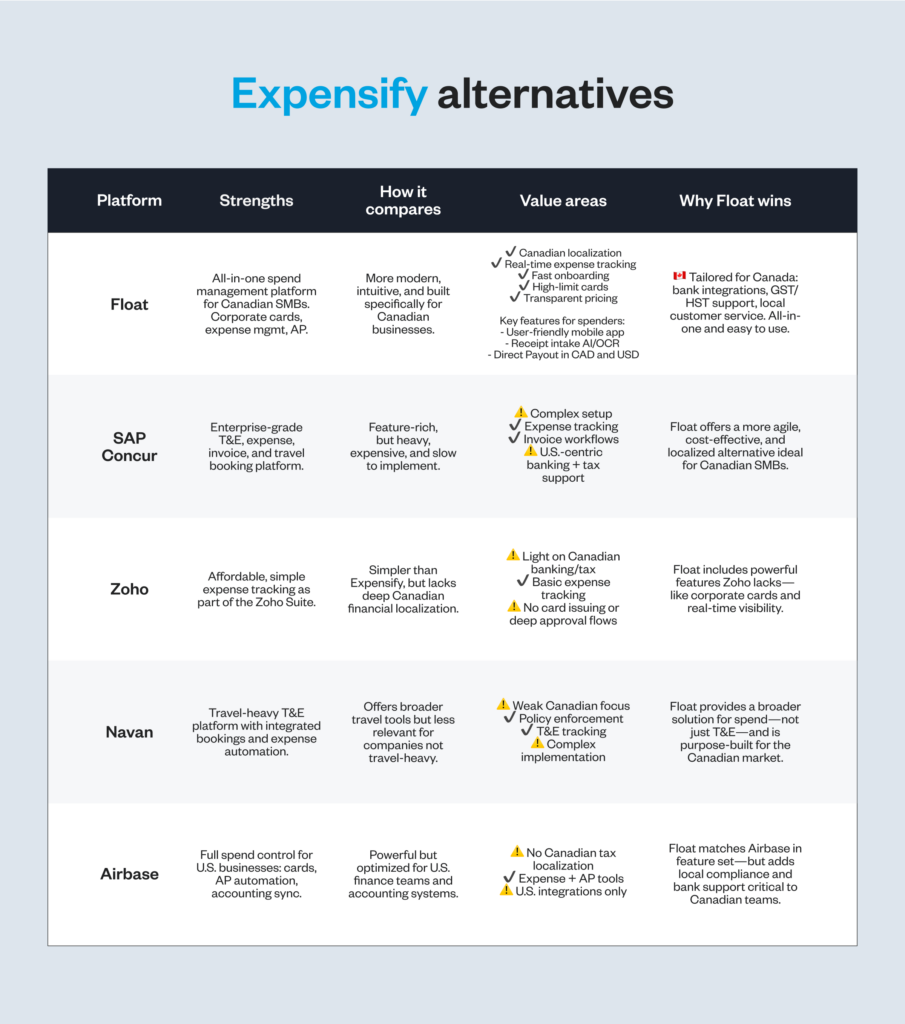
Canadian SMBs face unique challenges that many US-centric platforms overlook. For example, you need to issue and manage corporate cards in CAD, handle FX conversions smoothly, and track GST/HST accurately—taxes that vary by province and require CRA-compliant reporting. Float is built to handle all of that, right out of the box. With most other tools, these become an endless loop of support calls and emails that never go anywhere.

Curious how Float stacks up against the competition?

Our side-by-side breakdown highlights the key differences in Float vs. Expensify, along with other leading tools.

Compare Expensify Alternatives

comparison table of expensify alternatives

Canadian-based? Start with Float

If you’re a Canadian business searching for the best Expensify alternative, start with Float. Purpose-built for Canadian companies, it’s designed to simplify your expense management—without the complexity, hidden fees or inflexible workflows.

Not sure yet? Take the tools for a spin. Book demos, take advantage of free trials and get hands-on with the platforms that catch your eye. We’re confident that once you try Float, you’ll see the difference—especially when it comes to Float vs. Expensify.. Say hello to faster onboarding, local support and features that actually scale with your team.

Learn more about Float

Get a 10-minute guided tour through our platform.

And don’t forget to tap into the wisdom of other businesses in the same spot as you. Reddit threads, finance forums and Slack groups are gold mines for honest, unfiltered insights. Ask around. Learn what others love (and hate) about the tools they’ve tried. It’s one of the fastest ways to get a real-world sense of what will work best for your business.

Bottom line: expense management should work for you, not the other way around. Let’s make it easier, smarter and Canadian.

Credit Cards for Business Travel: Top Picks for Canadian Companies in 2026

Travelling for business is a great way to network with potential partners, connect with remote team members and expand your small business beyond borders—or simply past your city limits. If work takes your team out of town or across the globe, looking into the best business credit cards for travel is well worth it. 

Manufacturing, construction, finance and insurance companies tend to spend the most on business travel. But any company that needs to attend conferences or trade shows, hold meetings in other cities, visit production facilities or host team offsites and retreats should have business credit cards on hand to cover travel costs.

In this piece, we’ll talk about why you need to use a business credit card for travel and give you some pointers about how to select the right one. We’ve also rounded up some of the top travel cards out there to reveal the best business travel credit card for Canada.

What is a business credit card? 

A business credit card is a credit card that’s used exclusively for business-related spending. Business travel credit cards are a type of business credit card that gives you more bang for the bucks (pesos, euros, pounds, yuan or rupees) you spend when you travel. The best business travel credit cards can be used for all types of business purchases, but they also offer rewards around travel expenses such as points or cashback on transportation, hotels, meals and entertainment. Many also include built-in travel insurance and opportunities to access airport lounges or executive suites at hotels. 

Why is a business credit card important for travel expenses? 

Using a business credit card on trips helps you keep track of what you and your team spend when travelling for work. Business travel expenses, meals and entertainment can be deducted from your taxes. With a business credit card, all your eligible travel expenses end up in the same place, making it easy to accurately claim them during tax season. 

A business credit card also gives you more control over how your team spends company money while travelling. For example, Float Corporate Cards allow you to select where each card can be used and set daily or weekly spending limits. 

Which team members should get a credit card for business travel expenses? 

Ideally, everyone who takes a trip as part of their job should get a corporate card they can use to cover their eligible expenses. Paying travel costs out of pocket and waiting to be reimbursed can be stressful for your team members. With a solution like Float, team members can cover costs on the company’s dime while you make sure everyone spends only where they should.

Key considerations when choosing the best credit card for business travel expenses

You don’t necessarily have to use a business credit card that’s branded as a travel card for travelling—you can use any business credit card that works for you. Here are a few things you should keep in mind when researching the best business credit cards for travel:

  • Annual fees: Do they balance out with the rewards you get? 
  • Interest rate and grace period: Will they support your cash flow strategy? 
  • Travel insurance: Make sure you’re covered for common issues like flight cancellation and lost baggage. 
  • Points: Can you use points for more than just travel? 
  • Benefits: Look for benefits that make trips more comfortable like airport lounge access, hotel upgrades and car rental discounts. 
  • Partner ecosystem: Check if the airlines, hotel chains and restaurants that provide card benefits line up with your travel needs.

Try Float for free

Business finance tools and software made

by Canadians, for Canadian Businesses.

Best business credit cards for travel in Canada—and beyond

Choosing the right business credit card is a challenge in a sea of options. We’ve put together a shortlist to help you find the best travel business credit card Canada has to offer.

Float Corporate Card

If you’re looking for the best credit card for business travel expenses, look no further than Float. With Float Corporate Cards, you get exceptional purchase controls, automatic receipt capture and real-time expense insights so you can track and optimize how your team spends when they travel. You can issue unlimited physical and virtual cards for your whole team. Plus, Float puts money in your pocket with 1% cashback, a total average savings of 7%, and 4% interest when you keep a cash balance in Float. 

Scotiabank® Passport Visa Infinite Business Card

With no foreign transaction fees, this card is a great option for globetrotters and companies that make international purchases. Scotiabank offers expense management tools that include employee spend controls and expense tracking, plus automatic transaction export to major accounting software. 

CIBC Aeroplan® Visa Business Card

CIBC’s card offers 1.5x points on core business purchases like dining, shipping, internet, phone and transportation. Unfortunately, you have to book with Air Canada to get the most out of this option—sorry, WestJet loyalists. You can only get up to nine additional cards.

TD® Aeroplan® Visa Business Card

The slightly better-looking cousin of the CIBC card, TD offers pretty much the same points per dollar on business purchases but delivers on expense management tools. You still have to book with good ol’ Air Canada to max out the benefits. 

RBC Avion Visa Infinite Business

If you’re looking for an airline-agnostic option, RBC’s in your corner. You can book with any airline and get access to over 1,200 airport lounges. The card doesn’t offer the highest points per dollar but what it lacks in rewards, it makes up for in spend management features, such as multiple cardholders with basic limits and reports. But you’ll need to integrate with a third-party tool for true spend control, approval workflows or receipt capture. And this option only provides up to nine additional cards.

BMO® Ascend World Elite® Business Mastercard®

The standout benefit of this card is the cashback offered on business travel purchases plus unique experiences at restaurants and tourist destinations—like private tours of Versaille. It’s a rewarding option for travel lovers, but it might not help you run your business better as it doesn’t provide expense management tools.

BMO AIR MILES® No-Fee Business Mastercard®

This minimalist option from BMO is a good choice if you frequently spend on fuel as that’s where you’ll earn the most points. The card doesn’t come with travel insurance or perks at the airport, so you’ll be roughing it like the rest of us!

American Express Business Platinum Card®

In stark contrast to the BMO option above, this AMEX card comes with high fees in exchange for a bevy of benefits, including credits towards travel purchases. Bear in mind that American Express isn’t as widely accepted as Visa and Mastercard. 

Compare business travel credit cards for Canadian companies

CardAnnual feeRewardsTravel insuranceKey benefits
Float Corporate Card$0 (Unlimited Physical + Virtual cards)1% cashback on all purchases after the first $25K of monthly spend.XReal-time expense tracking
Receipt capture app
CAD and USD card options
Virtual and physical cards
4% interest on CAD and USD yield balances
Scotiabank® Passport Visa Infinite Business Card$199 (First supplementary card free, each additional card $50 annually)Earn 1.5 Scene+ points per dollar spentNo foreign transaction fees
Expense management tools
Complimentary airport lounge access
Benefits at participating hotels
Avis® Preferred Plus membership
Cashback on select purchases
CIBC Aeroplan® Visa Business Card$180 ($50 per additional card annually)Earn Aeroplan points on all purchases. Get 1.5–2x points per dollar spent in select categories.Free first checked bag with Air Canada
Maple Leaf Lounge™ passes
Avis® Preferred Plus membership
Fuel savings at select gas stations
TD® Aeroplan® Visa Business Card$149 ($49 per additional card annually)Earn Aeroplan points on all purchases.Get 1.5–2x points per dollar spent in select categories.Earn Starbucks® Stars.Expense management tools
Free first checked bag with Air Canada
Maple Leaf Lounge™ passes
Savings at Avis® and Budget®
Cashback on select purchases
RBC Avion Visa Infinite Business$175 ($75 per additional card annually)Earn 1.25x Avion points per dollar spent.
Expense management tools
Receipt capture app
Airport lounge access
Discounts at Hertz® Benefits at participating hotels
Fuel savings at Petro-Canada
BMO® Ascend World Elite® Business Mastercard®$149 ($50 per additional card annually)Earn 4x points for every dollar spent on core business purchases. Airport lounge access
Fuel savings at Shell1%–25% cashback on hotels, meals and fuel from select merchants
BMO AIR MILES® No-Fee Business Mastercard®$0 (no charge for additional cards)Earn 1x Air Mile for every $20 spent and 1.25x Miles at Shell stations.XFuel savings at Shell1%–25% cashback on hotels, meals and fuel from select merchants
American Express Business Platinum Card®$799 ($250 per additional card annually) Earn 1.5x points for every dollar spent.Expense management tools
$200 in annual travel credits
Airfare discounts
Airport lounge access
Benefits at participating hotels
Discounts at Hertz® and Avis®

How to choose the right business travel credit card

If you’re thinking about getting a business credit card, you’ve got to get a little introspective. Pull out your journal and determine what you (and your business) really need from your card. Here are a few prompts:

  1. Take a look at how you spend
    Revisit your expense reports and assess how much you’re currently spending on travel to determine whether a card’s rates and benefits support your business goals.
  2. Understand how your team travels
    Choose a provider that offers benefits from hotels, restaurants and airlines that your team is likely to use. 
  3. Consider who travels the most
    Think about which cards offer features that would truly benefit the frequent fliers on your team and make expense reporting easier for everyone.
  4. Pay attention to customer service and support
    Make sure that your team members can get the help they need if something comes up during their trip, even if it’s 3:00 AM in Mumbai. 

Try Float for free

Business finance tools and software made

by Canadians, for Canadian Businesses.

Get ready to fly with Float

With Float, you’ll never have to wade through an avalanche of expense receipts after a conference again. You can give all your team members a Float Corporate Card with set spending limits and allow them to seamlessly snap photos of their receipts on the go, so they can focus on working—and maybe having a little fun—while they’re away. 

Try Float free and say sayonara to tedious expense reports and hola to automatic approvals workflows, real-time spending insights and stress-free month-end reconciliation.

Best Credit Card for Startup Businesses in Canada

Starting a business sounds thrilling until it’s time to manage the finances. From unpredictable cash flow to early-stage scaling, startup founders are juggling a lot. Finding the best credit card for startup businesses can make a surprisingly big impact.

Financial matters are rarely far away from a founder’s mind. Funding is the most pressing challenge in Canada, worrying 66.8% of startup owners. Another 40% worry about cash flow, 34% worry about accessing bank loans and 14% are concerned with debt repayment. This isn’t exactly the path to getting any beauty sleep. 

In this guide, we’ll explain why startups have unique financial needs, what to look for in a business credit card and how to choose the right option for your early-stage company.

Why startup businesses have unique financial needs

Startups operate in a pressure cooker of growth and uncertainty, and we don’t mean the kind that turns out a quick and delicious pulled pork. These entrepreneurs are balancing tight budgets, early traction and aggressive goals, all while trying to build systems that won’t collapse under future growth.

That means every financial tool needs to work overtime. Founders need flexibility to cover expenses, visibility to track spend and the ability to scale without constantly reinventing the wheel. 

What is a business credit card?

A business credit card is designed specifically for business spending on expenses like travel, subscriptions, equipment and marketing. Unlike personal cards, business credit cards often come with higher limits, built-in expense tracking and the option to issue cards to employees with custom spending rules.

Figuring out how to get a business credit card for your startup will also help keep business and personal finances separate, which makes tax season a lot less stressful. (You’re welcome, accountants).

Try Float for free

Business finance tools and software made

by Canadians, for Canadian Businesses.

Why is a business credit card important for startups?

Startups typically start scrappy, sometimes using personal credit cards to cover initial costs. But as spend ramps up and the team grows, the downsides become clear fast. Reimbursements create more admin, and those personal credit limits? Not built for scaling.

A business credit card gives your startup a dedicated line of credit and clearer financial control. It also helps you:

  • Smooth out cash flow
  • Build your business credit history
  • Reduce fraud risk with virtual cards and spending limits
  • Earn cashback or rewards for business purchases
  • Streamline how your team spends (and how you track it)

Common financial challenges for startups

Founders wear a lot of hats, including those of CEO, CFO and sometimes IT support. Managing the complexity of startup financials can quickly feel like a full-time job.

Here are a few challenges Canadian startup owners face:

  • Cash flow gaps

Startups don’t always get paid on time (or at all), so being able to delay payments by a billing cycle gives some breathing room.

  • Scaling costs

Hiring, marketing and software costs can spike without warning. A credit card offers flexibility to cover expenses during high-growth moments.

  • Disorganized spending

Without proper systems, it’s easy to lose track of who spent what and why. A business card with smart controls and real-time tracking can fix that.

  • Limited access to capital

Early-stage businesses may not qualify for loans, so a credit card with no personal guarantee (like Float’s charge card) can offer vital access to funds without tying it to the founder’s personal credit.

Key considerations for startups 

Once you figure out how to get a business credit card for a startup, it’s time to consider which card is right for you. Look for cards that offer real value in building a robust credit card program, not flashy perks you won’t use.

When choosing a business credit card for startups, here’s what to look for.

No personal guarantee

Ideally, the card won’t be tied to your personal credit, so your risk is limited if the business hits a rough patch.

Flexible underwriting

Look for cards that assess your business based on cash flow or funding, not just time in business or credit score.

Virtual cards and controls

The ability to issue employee cards, set spending limits and restrict certain types of purchases is key to keeping spend in check.

Real-time tracking and software integrations

This is a key factor. Your card should help you close the books faster, not slow you down with manual work.

Cashback or rewards

Choose a card that gives something back for the way your startup actually spends, whether that’s SaaS, ads or travel.

Best business credit cards

Compare top options, fees and benefits for

Canadian companies.

Best credit cards for startup businesses in Canada

Here’s a look at business credit cards that make sense for Canadian startups, whether you’re bootstrapping or scaling fast.

Float Corporate Card

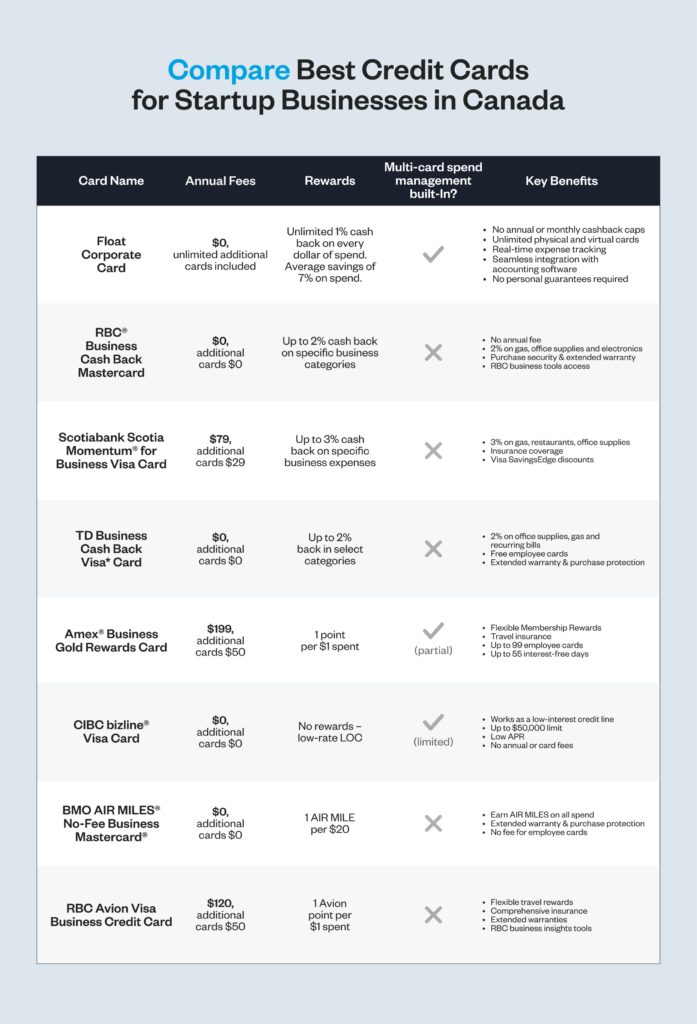
With unlimited 1% cashback, no annual fees and no personal guarantees required, Float is purpose-built for startups that want to streamline finance ops for faster growth trajectories. Features like unlimited virtual cards, real-time expense tracking and seamless software integrations make this card a top choice for early-stage companies wanting financial systems to grow with them—especially when it comes to managing spend from multiple cards.

RBC® Business Cash Back Mastercard

This cash-back card from RBC rewards practical business spending, such as gas, electronics and office supplies, with 2% back on eligible categories. It’s a no-fee option that offers purchase protection and extended warranties, but the rewards program is less flexible than some competitors. Important to note that no spend management software is included. RBC’s online banking portal has limited features, so you’d have to integrate third-party tools like Expensify to get this functionality.

Scotiabank Scotia Momentum® for Business Visa Card

This Scotiabank card offers 3% cash back in a few key spending categories, which is a step up for businesses with predictable monthly costs. Restaurants, gas stations and office supply stores all earn higher rewards. It offers decent value for founders who don’t mind the $79 annual fee but may be overkill for early-stage startups with lighter spend. Again, no spend management software is included, which means you’ll be managing multiple cardholders and spend through basic banking portal tools and manual tracking or third-party apps.

TD Business Cash Back Visa Card

This is TD’s no-fee business credit card, and it’s designed to keep things straightforward. You’ll earn 2% cash back on office supplies, gas and recurring bills, with purchase protection and warranty extensions baked in. It fits early-stage businesses that want simple rewards and a reliable issuer, but the perks may not scale as well as other options on this list. No native spend management software or tools here either, so this is a good option for founders who want just the basics and plan to manually manage receipts and spending.

American Express® Business Gold Rewards Card

If your startup spends big, especially on ads, software or travel, this premium card from Amex offers plenty of value. You’ll earn Membership Rewards points, benefit from expense tracking tools and get access to travel perks and insurance. The $199 annual fee is high, so it might only be worth it for founders who aren’t looking to cut costs or who know how to really get the most out of Amex points. Amex does have some built-in expense tracking that allows you to download statements, receipts and categorize spending, as well as run an employee card program. But there are no real-time spend alerts or approval workflows and no automated reconciliation of receipts (unless you integrate a third-party tool).

CIBC bizline® Visa Card

This is more like a credit line in card form. With low interest rates and no annual fee, the CIBC bizline is a strong pick for startups that want simple access to funds without racking up debt. It’s light on perks but heavy on utility. If you’re focused on stability and managing cash flow over chasing rewards, it’s worth a look. But, it won’t be a great option for scaling spend as the company grows, since it offers very limited tools, no real-time spend control, no employee card tools and no integrations.

BMO AIR MILES® No-Fee Business Mastercard®

For startups that already collect AIR MILES, this card helps you stack rewards on business spending without an annual fee. You’ll earn 1 mile for every $20 in purchases and get basic protections like extended warranties, but miles aren’t as flexible as cashback. No spend management software included. No need for multi-card oversight? This may be the option for you, since it does not support multiple cardholders, team-level controls or integrations for spend management software.

RBC Avion Visa Business Credit Card

This RBC card is built for businesses with travel in their plans. With Avion points earned on every purchase, it’s a good choice for companies that want flexibility and premium travel perks. The $120 fee gets you a rewards program and insurance coverage, but it may be better suited for more established scale-ups with frequent travel needs. One step up from the basic RBC business cashback, this card offers some spend management features like multiple cardholders with basic limits and reports, but you’ll need to integrate with a third-party tool for true spend control, approval workflows or receipt capture.

Comparison chart of top business credit cards in Canada for startups, showing annual fees, rewards, multi-card spend management, and key benefits for 8 cards including Float, RBC, Scotiabank, TD, Amex, CIBC, BMO, and RBC Avion.

How to choose the best credit card for your startup business

Choosing a business credit card for a startup is much like choosing a co-founder. It needs to be a good fit for how you operate now and how you plan to grow. Before you apply, make sure you understand your current financial position. 

Take Properly, a Canadian real estate company that turned to Float’s solution to create a solid framework for company spend and approvals.

“As a startup, our credit card limit was low and our spend policies were essentially non-existent. What we had wasn’t scalable and Float turned it all around,” says Rhianna, finance director at Properly.

Match the card to your spend categories, and choose rewards and features that deliver long-term value. If your biggest costs are software and ads, a travel-heavy rewards card probably isn’t the right call. 

“Float gives us the flexibility to set up cards with different titles, controls and spending limits,” says Rhianna. “Float also gives our finance team the power to spot and audit expenses coming through in real time.”

Alternative funding options

A business credit card is just one piece of the puzzle. Many startups don’t yet have years of credit history or steady revenue, so traditional financing options may not be within reach. Some startup businesses can benefit from a layered funding approach that may include lines of credit, venture debt or grants and government funding. 

With some creativity, you can combine funding to offer you flexible access or a bit more runway when needed. Pairing a smart credit card with other funding tools can give your business more resilience, growth potential and less stress.

Float: Business credit cards tailored for startups in Canada

Float offers a business credit card and spend management platform with solid benefits for Canadian startups, giving you the tools to make your money work harder.

With flexible approvals, real-time expense tracking and unlimited virtual cards, Float helps early-stage companies move faster, stay in control and build a foundation for future funding.

Filing Small Business Taxes for the First Time in Canada? Start Here

Filing small business taxes for the first time in Canada can feel like stepping into a maze—full of rules, forms and deadlines. If you’re a new entrepreneur trying to figure it all out, you’re not alone, and you’re definitely not the first to Google, “how to file business taxes in Canada.”

In this guide, we’ll walk you through everything you need to know to file your business taxes in Canada for the first time—from key dates to tax rates, to the tools that make it easier. With the right information and a step-by-step approach, you can file your small business taxes confidently, avoid costly mistakes and maybe even spot a few ways to save.

Important dates for filing small business taxes in Canada

When it comes to taxes, timing matters. Missing a deadline can lead to penalties, interest charges or unnecessary stress. Here are the key tax dates every small business owner in Canada should keep in mind:

Personal tax deadline (for sole proprietors and partnerships)

Due: April 30
If you operate as a sole proprietor or in a partnership, your business income is reported on your personal tax return. That means your return is due by April 30.

You technically have until June 15 to file, but any taxes owed must still be paid by April 30. Filing late, even if you don’t owe anything, can trigger interest charges if payment is delayed.

Corporate tax deadline (for incorporated small businesses)

Due: Six months after your fiscal year-end
If your business is incorporated, your T2 corporate income tax return is due six months after your fiscal year-end. For example, if your fiscal year ends on December 31, your filing deadline is June 30.

Keep in mind: For any Canadian-controlled private corporation (CCPC), any taxes owed are still due three months after your fiscal year-end, regardless of your filing deadline. Late payments may result in interest and penalties. If you’re not a CCPC, the timeline shortens to two months.

Sophie Dillon is a co-founder at Orbit Accountants, an accounting firm specializing in bookkeeping, tax, payroll, and fractional CFO services for SMEs. “If you owe more than $3,000 in corporate income tax, the CRA may require you to start making installment payments the following year,” says Sophie. “These prepayments help spread out your tax burden and avoid interest charges.”

GST/HST filing deadlines

If your revenue exceeds $30,000 in a 12-month period, you’re required to register for a GST/HST number and begin collecting and remitting sales tax.

Your GST/HST return deadline depends on how frequently you file:

  • Annually: three months after your fiscal year-end
  • Quarterly: one month after each quarter-end
  • Monthly: one month after each month-end

If you’re just filing for the first time, you will file GST/HST at the end of your first fiscal year.

Understanding your business structure and tax obligations

Before you can file your taxes, you need to understand how your business structure affects what you owe and how you file. In Canada, there are three main types of business structures:

Sole proprietorship

This is the simplest business structure and the most common for first-time entrepreneurs. You and your business are considered the same legal entity, which means:

  • You report business income on your personal tax return (T1) using Form T2125
  • You pay tax at your personal income tax rate
  • You may also need to pay Canada Pension Plan (CPP) contributions on your net self-employment income

Partnership

A partnership is similar to a sole proprietorship but involves two or more people. Each partner reports their share of the business income or loss on their personal tax return. You’ll need to:

  • File a Partnership Information Return (T5013) if the partnership meets certain criteria (like having more than $2 million in assets or revenue)
  • Report your share of income using Form T2125
  • Pay taxes at your personal income tax rate

Corporation

A corporation is a separate legal entity from its owner(s), which means it files its own tax return (T2) and pays taxes at corporate rates. If you’re incorporated, you’ll need to:

  • File a T2 Corporate Income Tax Return annually
  • Pay tax at the small business tax rate in Canada if you qualify for the small business deduction (more on that in the next section)
  • File and remit payroll taxes, GST/HST, and possibly T4s for any employees or shareholders

“Even if you’re the 100% shareholder, your corporation is a separate legal entity in the eyes of the CRA. That means filing a T2 return for the business, on top of your personal taxes,” says Sophie. 

Your structure impacts not just how much you pay in taxes, but also how you manage cash flow, pay yourself, and take advantage of deductions. Choosing the right one from the start (and understanding what it means at tax time) sets you up for success.

Step-by-step guide to filing small business taxes in Canada (for corporations) 

If you’re running an incorporated small business, your tax responsibilities are more involved than those of a sole proprietor—but with the right process, they’re totally manageable.

Here’s a step-by-step breakdown of how to file small business taxes in Canada as a corporation:

Step 1: Know your fiscal year-end

Your corporation’s fiscal year can be any 12-month period, but most small businesses align it with the calendar year (ending December 31). This date determines your tax deadlines, including when your T2 return and payments are due.

Step 2: Gather your financial records

Before you can file, you’ll need accurate, up-to-date financial records. This includes:

  • Profit and loss statements
  • Balance sheets
  • Payroll records
  • Receipts for expenses
  • Bank and credit card statements
  • Records of dividends or shareholder payments

If you’re using accounting software, or an integrated platform like Float to manage expenses and receipts, this step is a lot easier.

Step 3: Prepare your T2 corporate tax return

The T2 return is the form all corporations in Canada must file. It includes detailed financial information, business activities and tax calculations. Even if your business doesn’t owe any tax, you still have to file a return. Most businesses also need to complete a General Index of Financial Information (GIFI) to report financial data.

Unless you’re a tax expert or your business is very simple, most incorporated businesses work with an accountant to file their T2 accurately.

Step 4: Claim your deductions and tax credits

Corporations can deduct eligible business expenses—everything from salaries to office supplies—to reduce taxable income. Depending on your industry and situation, you may also be eligible for federal or provincial tax credits.

Your accountant can help identify what you qualify for, but common deductions include:

  • Business-related travel and meals
  • Salaries and wages
  • Utilities and rent
  • Software subscriptions
  • Professional services (legal, accounting, etc.)

Step 5: File electronically through CRA

Corporations are required to file their T2 return electronically using CRA-approved tax software. Most accountants and tax professionals handle this for you, but it’s important to confirm the return has been submitted on time.

Step 6: Pay any taxes owed

Even if you’re not filing your return right away, corporate income taxes are due within three months of your fiscal year-end. Payments can be made through your financial institution, via your CRA My Business Account, or using pre-authorized debit.

If you expect to owe more than $3,000 in taxes annually, you may need to make monthly or quarterly installment payments the following year.

Understanding small business tax rates in Canada

One of the benefits of incorporating in Canada is access to lower corporate tax rates, especially if your business qualifies as a CCPC. But understanding how those rates actually work is key to managing cash flow and staying compliant.

The small business deduction

Most incorporated small businesses in Canada qualify for the small business deduction (SBD), which reduces the amount of tax you pay on your first $500,000 of active business income. To qualify, your business must be:

  • A Canadian-controlled private corporation (CCPC)
  • Earning active business income (not investment income or capital gains)
  • Operating primarily in Canada

With the SBD, your combined federal and provincial tax rate on the first $500,000 of income can be as low as 9% to 15%, depending on your province or territory.

General corporate tax rate

Once your income exceeds the $500,000 threshold, or if you don’t qualify for the SBD, you’ll pay the general corporate tax rate, which is higher. Federally, that rate is 15%, plus a provincial portion that varies. Combined, you’re looking at rates between 25% and 31% for most regions.

Passive income and investment income

Keep in mind that passive income (like rental income or interest from investments) is taxed at a much higher rate for corporations—often 38% or more. If your corporation earns significant passive income, it may also reduce your eligibility for the small business deduction.

Understanding which tax rates apply and how to stay within the lower brackets can have a huge impact on your bottom line. That’s where planning ahead with your accountant or tax advisor pays off.

Common mistakes to avoid when filing business taxes

Filing small business taxes for the first time in Canada comes with a learning curve. Here are some of the most common issues to watch out for, and how to avoid them.

Missing deadlines

Late filings or payments can result in penalties and interest charges. Remember:

  • Your T2 return is due six months after your fiscal year-end
  • Your payment is due three months after year-end
  • GST/HST and payroll remittances have their own filing schedules

“One thing that trips up a lot of first-time filers is the difference between when your return is due and when your payment is due,” says Sophie. “Your T2 corporate return is due six months after your fiscal year-end, but any taxes you owe must be paid within three months if you are a CCPC with taxable income under $500,000. If you wait until the filing deadline and haven’t paid, you could already be late. It’s an easy detail to miss, but an important one.”

Mark these deadlines clearly, and consider setting calendar reminders or using software that helps automate due-date tracking.

Mixing personal and business expenses

If you’re not keeping business and personal spending separate, it’s harder to track deductions, and it could raise red flags with the CRA.

  • Use a separate business bank account and credit card
  • Keep detailed records and receipts for all expenses
  • Don’t claim personal expenses as business write-offs

Tools like Float can help your team manage spending in real time and categorize expenses correctly from the start.

Not claiming all eligible deductions

Many small business owners underclaim because they’re unsure what qualifies. Commonly missed deductions include:

  • Home office expenses (if you work from home)
  • Using your vehicle for business purposes
  • Software subscriptions and professional development
  • Meals and travel for client-related activities

A good accountant can help you find legitimate deductions and stay within CRA guidelines.

Forgetting to track GST/HST

If you’re collecting GST/HST, you’re responsible for tracking it properly and remitting it on time. Mistakes like forgetting to remit, underreporting or claiming input tax credits incorrectly can lead to audits or penalties. 

Not sure if you need to register yet?

Here’s how to know when it’s time to register for a HST number.

Filing manually or without support

In Canada, 44% of SMBs struggle with inefficient financial reporting processes. Mix in the fact that filing a T2 return is more complex than a personal tax return, trying to do it all manually—or without professional support—can lead to errors or missed opportunities. Save yourself the headache by investing in expert help or software that’s built for Canadian corporations.

Tools and resources to simplify tax filing

Accounting software

Digital accounting platforms are like a trusty sidekick when it comes to tracking income, expenses, and generating the reports you’ll need to complete your corporate tax return. Most allow you to automate repetitive tasks, categorize transactions, and share real-time financial data with your accountant or bookkeeper. Look for a system that fits your business size and integrates well with your other financial tools.

If you’re already using Float, our platform integrates seamlessly with these popular accounting platforms, so your financial data can stay accurate and up to date:

  • QuickBooks Online – Ideal for small businesses managing day-to-day bookkeeping and cash flow.
  • Xero – A go-to for startups and growing teams that need simple, collaborative accounting.
  • NetSuite – Built for mid-market and enterprise companies with more complex financial operations.

CRA’s My Business Account

The Canada Revenue Agency’s My Business Account is your online hub for managing federal tax obligations. Through this portal, you can:

  • File corporate income tax and GST/HST returns
  • View account balances and notices of assessment
  • Make payments or set up instalments
  • Manage payroll accounts
  • Authorize a representative (such as your accountant)

Registering for this portal early on gives you full visibility and makes it easier to stay compliant.

Receipt and expense tracking tools

Keeping accurate records is so important—not just at tax time, but all year round. 

“One of the biggest mistakes we see is business owners scrambling at year-end to remember what expenses they had ten months ago or trying to chase down receipts. Tracking as you go makes a huge difference,” says Sophie. 

Expense management tools can help your business:

  • Capture and store receipts digitally
  • Monitor spending in real time
  • Categorize purchases for easier bookkeeping
  • Create clear audit trails for deductions

The more automated and centralized your system, the easier it will be to prepare for filing and support your claims if you’re ever audited.

Professional support

Hiring a qualified bookkeeper or accountant is a worthwhile investment. They can help ensure your tax return is accurate, maximize deductions and guide you through installment payments or tax planning strategies. You’ll be thankful you did it in the long run! 

How Float can help

Tax season might come once a year, but the systems you put in place today can make the process smoother every time. At Float, we help small businesses across Canada simplify financial operations and stay tax-ready all year round. With Float, you can:

  • Eliminate the paper chase at tax time
  • Keep business purchases organized and categorized
  • Improve accuracy in your bookkeeping
  • Make month-end and year-end processes faster and easier
  • Support your accountant with the data they need, when they need it

Ready to make tax season stress-free? Book a demo or get started with Float to take control of your business spending today.

Learn more about Float

Get a 10-minute guided tour through our platform.

Disclaimer: This article is for informational purposes only and does not constitute financial, tax, or legal advice. Every business is unique, and tax rules can change or vary depending on your specific circumstances. We recommend consulting a qualified accountant or tax professional to ensure you’re making the right decisions for your business.