


Corporate Cards
Best Business Credit Cards for Travel Canada: 2026 International Guide
Find the best business travel credit card Canada has to offer and make travel expense tracking a breeze.
May 22, 2026
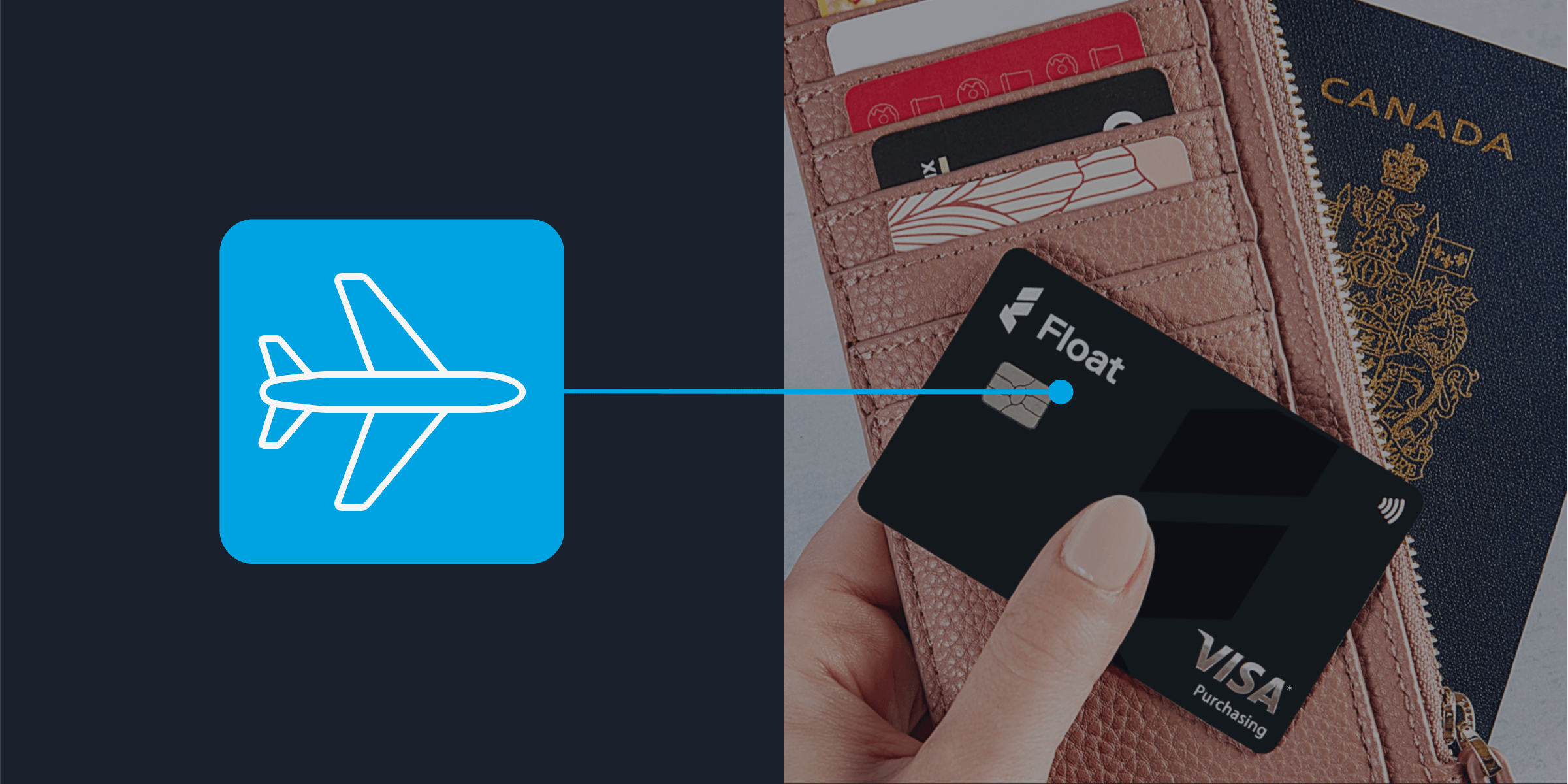


Travelling for business is a great way to network with potential partners, connect with remote team members and expand your small business beyond borders—or simply past your city limits. If work takes your team out of town or across the globe, looking into the best business credit cards for travel is well worth it.
Manufacturing, construction, finance and insurance companies tend to spend the most on business travel. But any company that needs to attend conferences or trade shows, hold meetings in other cities, visit production facilities, or host team off-sites and retreats should have business credit cards on hand to cover travel costs.
In this piece, we’ll talk about why using a business credit card for travel matters, what to look for when choosing the right one and how different options perform for international spend. We’ve also rounded up some of the top travel cards to help you find the best business travel credit card for Canadian companies.
What is a business credit card?
A business credit card is a card that’s used exclusively for business-related spending. Business travel credit cards are a type of business credit card that gives you more bang for the bucks (pesos, euros, pounds, yuan or rupees) you spend when you travel.
The best business travel credit cards can be used for all types of business purchases and also offer rewards for travel expenses. These rewards can include points or cashback on transportation, hotels, meals and entertainment. Many of these cards also offer built-in travel insurance and access to airport lounges or hotel executive suites.
Why is a business credit card important for travel expenses?
Using a business credit card on trips helps you keep track of what you and your team spend when travelling for work. You can also deduct business travel expenses, meals and entertainment from your taxes. With a business credit card, all of your eligible travel expenses end up in the same place, making it easy to accurately claim them during tax season.
A business credit card also gives you more control over how your team spends company money while travelling. For example, Float Corporate Cards let you specify where each card can be used and set daily or weekly spending limits.
Which team members should get a credit card for business travel expenses?
Ideally, everyone who takes a work trip should receive a corporate card to cover eligible expenses. Waiting to be reimbursed for travel costs paid out of pocket can be stressful for your team members. With a solution like Float, team members can cover costs on the company’s dime while you make sure everyone spends only where they should.
2026 international business travel trends and credit card needs
Business travel is back, and it looks different from what it did pre-2020.
According to the Global Business Travel Association Business Travel Index Outlook, global business travel spending was estimated at $1.57 trillion USD in 2025, with growth projected at 8.1% in 2026. This is expected to increase to more than $2 trillion USD by 2029 as cross-border trade, investment and corporate travel continue to expand, even in the face of economic and geopolitical uncertainty.
Many Canadian companies are also travelling more frequently, especially to the US.Teams are also spending more in USD, purchasing SaaS tools from international vendors and operating cross-border earlier in their growth journeys. That shift has exposed a major gap: many traditional business credit cards weren’t built for international-first spending.
Finance teams are now reviewing their travel cards for a few important reasons:
- Foreign exchange (FX) fees can add 2.5% or more to every international transaction
- Card declines abroad can disrupt trips and business relationships
- Manual expense reporting doesn’t scale easily
- Rewards often favour a single airline or ecosystem
The best business credit cards for travel in 2026 need to support international acceptance, FX efficiency and modern spend control, not just points.
Key considerations when choosing the best credit card for business travel expenses
You don’t necessarily have to use a business credit card that’s branded as a travel card for travelling. You can use any business credit card that works for you. Here are a few things you should keep in mind when researching the best business credit cards for travel:
- Annual fees: Is the fee worth the awards you get?
- Interest rate and grace period: Will they support your cash flow strategy?
- Travel insurance: Make sure you’re covered for common issues like flight cancellation and lost baggage.
- Points: Can you use points for more than just travel?
- Benefits: Look for benefits that make trips more comfortable like airport lounge access, hotel upgrades and car rental discounts.
- Partner ecosystem: Check whether the airlines, hotel chains and restaurants that offer card benefits align with your travel needs.
Foreign transaction fee comparison: Canadian business cards
One of the biggest hidden costs for international business travel are foreign transaction fees.
Most Canadian business credit cards charge around 2.5% per foreign transaction. That fee applies to flights, hotels, meals, rideshares antd even conference registrations charged in any non-CAD currency. For teams that travel or spend cross-border frequently, those costs add up quickly.
For example, $10,000 USD in international spend is approximately $250 USD in FX fees alone.
Some cards waive foreign transaction fees, while others offset them with points or travel perks. But rewards don’t always fully neutralize FX costs, especially when redemptions are restricted to specific airlines or programs.
That’s why many finance teams are shifting their focus from “no FX fee” claims to FX visibility and control. Understanding when spend occurs in USD, how often currency conversion happens and how FX impacts cash flow matters more as international spend scales.
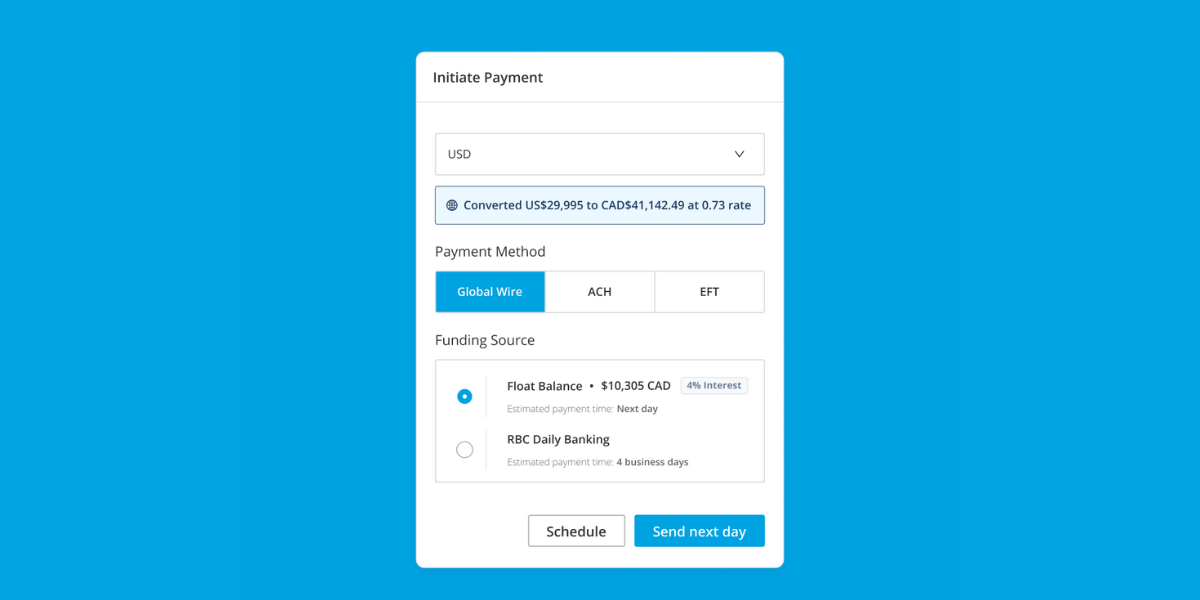
Float FX supports international business travel, and US travel in particular, with CAD and USD card options and FX-aware spend tracking, helping teams reduce unnecessary conversion costs while keeping all travel spend visible in one place.
Best business credit cards for travel in Canada—and beyond
When comparing business credit cards for international travel, rewards are only part of the equation. Canadian companies need cards that work reliably abroad, minimize FX costs, scale across teams and give finance leaders real-time visibility into spend.
Below, we evaluate each option through an international business lens.
Float Corporate Card
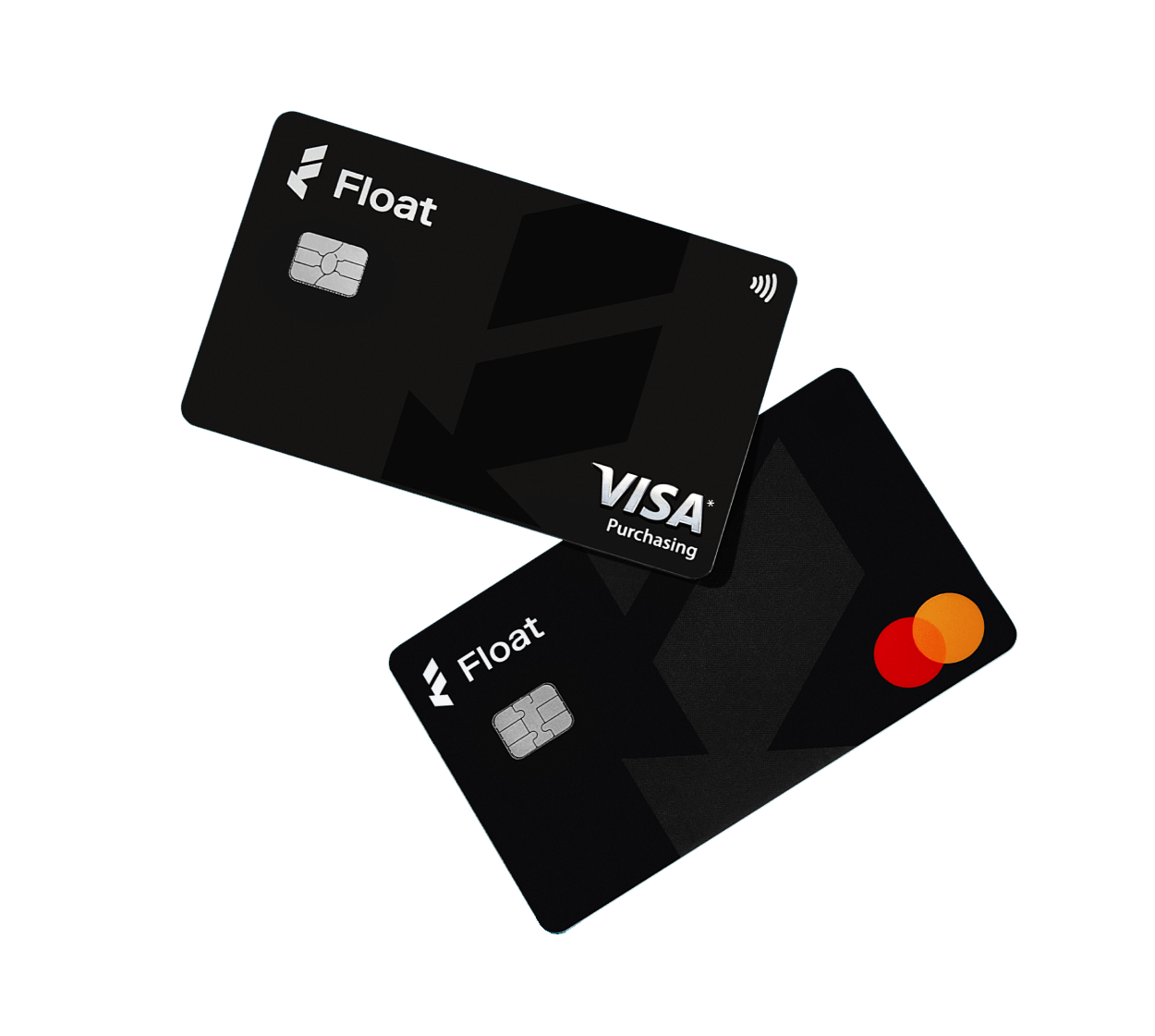
If you’re looking for the best credit card for business travel expenses, look no further than Float. With Float corporate cards, you get exceptional purchase controls, automatic receipt capture and real-time expense insights so you can track and optimize how your team spends when they travel. You can issue unlimited physical and virtual cards for your whole team. Plus, Float puts money in your pocket with 1% cashback and other rewards. Float corporate cards also include car rental insurance, an important benefit for teams travelling internationally.
Scotiabank® Passport Visa Infinite Business Card
With no foreign transaction fees, this card is attractive for international travel, though card limits and controls may feel restrictive for fast-growing teams. Scotiabank offers expense management tools that include employee spend controls and expense tracking, plus automatic transaction export to major accounting software.
CIBC Aeroplan® Visa Business Card
CIBC’s card offers 1.5x points on core business purchases like dining, shipping, internet, phone and transportation. While points are strong for Air Canada loyalists, FX fees and airline dependency can limit flexibility for international business travel.
TD® Aeroplan® Visa Business Card
The slightly better-looking cousin of the CIBC card, TD offers pretty much the same points per dollar on business purchases but delivers on expense management tools. Similar trade-offs apply for international spend, with rewards tied closely to Air Canada and limited scalability across teams.
BMO® Ascend World Elite® Business Mastercard®
The standout benefit of this card is the cashback offered on business travel purchases plus unique experiences at restaurants and tourist destinations—like private tours of Versailles. It’s a rewarding option for travel lovers, but it might not help you run your business better as it doesn’t provide expense management tools.
BMO AIR MILES® No-Fee Business Mastercard®
This minimalist option from BMO is a good choice if you frequently spend on fuel, as that’s where you’ll earn the most points. The card doesn’t come with travel insurance or perks at the airport, so you’ll be roughing it like the rest of us!
American Express Business Platinum Card®
In stark contrast to the BMO option above, this AMEX card comes with high fees in exchange for a bevy of benefits, including travel purchase credits. Bear in mind that American Express isn’t as widely accepted as Visa and Mastercard, especially outside of North America.
How Float’s travel benefits support international business
For Canadian companies operating globally, travel cards need to do more than earn points.
Float supports international business travel by combining:
- CAD and USD card options
- Wide international acceptance through major card networks
- Car rental insurance included
- Real-time spend controls and approvals
- Automatic receipt capture on the go
That means fewer declines, fewer reimbursements and cleaner month-end reconciliation, wherever your team may be.
Float customers like Toonie Tours use the platform to manage international spend without losing visibility or control. They maintain control even as their teams travel frequently and transact across currencies.
Compare business travel credit cards for Canadian companies
For international business travel, the biggest differences come down to foreign transaction fees, global acceptance, spend controls and how easily finance teams can manage expenses across currencies.
| Card | Annual fee | Rewards | Travel insurance | Key benefits |
| Float Corporate Card | $0 (unlimited physical + virtual cards) | 1% cashback on all purchases after the first $25K of monthly spend | X (includes car rental insurance; does not include full travel insurance bundle) | – Real-time expense tracking – Receipt capture app – CAD and USD card options – Virtual and physical cards – 3.5% interest on eligible CAD and USD balances |
| Scotiabank® Passport Visa Infinite Business Card | $199 (First supplementary card free, each additional card $50 annually) | Earn 1.5 Scene+ points per dollar spent | ✓ | – No foreign transaction fees – Expense management tools – Complimentary airport lounge access – Benefits at participating hotels – Avis® Preferred Plus membership – Cashback on select purchases |
| CIBC Aeroplan® Visa Business Card | $180 ($50 per additional card annually) | Earn Aeroplan points on all purchases. Get 1.5–2x points per dollar spent in select categories | ✓ | – Free first checked bag with Air Canada – Maple Leaf Lounge™ passes – Avis® Preferred Plus membership – Fuel savings at select gas stations |
| TD® Aeroplan® Visa Business Card | $149 ($49 per additional card annually) | Earn Aeroplan points on all purchases. Get 1.5–2x points per dollar spent in select categories. Earn Starbucks® Stars | ✓ | – Expense management tools – Free first checked bag with Air CanadaMaple Leaf Lounge™ passes – Savings at Avis® and Budget® – Cashback on select purchases |
| BMO® Ascend World Elite® Business Mastercard® | $149 ($50 per additional card annually) | Earn 4x points for every dollar spent on core business purchases | ✓ | – Airport lounge access – Fuel savings at Shell – 1%–25% cashback on hotels, meals and fuel from select merchants |
| BMO AIR MILES® No-Fee Business Mastercard® | $0 (no charge for additional cards) | Earn 1x Air Mile for every $20 spent and 1.25x Miles at Shell stations | X | – Fuel savings at Shell – 1%–25% cashback on hotels, meals and fuel from select merchants |
| American Express Business Platinum Card® | $799 ($250 per additional card annually) | Earn 1.5x points for every dollar spent | ✓ | – Expense management tools – $200 in annual travel credits – Airfare discounts – Airport lounge access – Benefits at participating hotels – Discounts at Hertz® and Avis® |
Business travel expense management with credit cards in 2026
In 2026, one of the biggest challenges in business travel is controlling spend on international trips.
As teams travel more frequently across borders, finance confirms a familiar pattern: more cards in circulation, more currencies and more edge cases. Traditional travel workflows, like reimbursements or post-spend reviews, break down quickly when employees are travelling across time zones and charging expenses in USD or other foreign currencies.
Many teams eventually move beyond standalone travel cards toward a broader corporate card program designed to support international spend at scale.
Finance teams need:
- Real-time visibility into travel spend as trips are happening
- Policy enforcement and pre-spend controls
- Automatic receipt capture so expenses don’t pile up at month-end
- Centralized reporting across currencies, cards and travellers
For these reasons, Canadian companies are moving away from travel-only credit cards toward corporate card programs designed for operational scale. Finance teams can support global mobility without sacrificing on control, cash flow visibility or audit readiness when travel spend is a core category.
Canadian vs. US business travel credit cards: 2026 comparison
As Canadian companies expand internationally, many finance leaders consider US-issued business credit cards to gain better rewards or USD-native spending. At first, these cards can look attractive. But for most companies, they often introduce more complexity.
Common challenges with US-issued business cards include:
- Requiring a US legal entity and US tax ID
- Needing US banking relationships
- Added compliance, accounting and operational overhead
These challenges are amplified when the core team, finance function and reporting remain based in Canada.
There are also practical limitations. US cards are typically designed around US expense policies, US accounting systems and US support hours. As international travel increases, reconciling spend across entities, currencies and card programs quickly becomes cumbersome.
Canadian-issued business credit cards, by contrast, are built to align with Canadian tax rules, accounting standards and reporting requirements. When paired with USD spending capabilities and FX-aware tooling, they can support international travel without forcing teams to manage parallel card programs or complex cross-border structures.
For most Canadian businesses, Canadian-issued cards designed for global spend offer a simpler, more scalable foundation for international business travel.
How to choose the right business travel credit card
If you’re thinking about getting a business credit card, you’ve got to get a little introspective. Pull out your journal and determine what you (and your business) really need from your card. Here are a few prompts:
- Take a look at how you spend: Revisit your expense reports and assess how much you’re currently spending on travel to determine whether a card’s rates and benefits support your business goals.
- Understand how your team travels: Choose a provider that offers benefits from hotels, restaurants and airlines that your team is likely to use.
- Consider who travels the most: Which cards offer features that would truly benefit the frequent fliers on your team and make expense reporting easier for everyone?
- Pay attention to customer service and support: Make sure your team members can get the help they need if something comes up during their trip, even at 3:00 a.m. in Mumbai.
Get ready to travel smarter with Float
With Float, business travel doesn’t have to create extra work for your finance team. Issue corporate cards with clear spending limits, automatically capture receipts, and keep travel spend visible in real time—whether your team is travelling domestically or internationally.
Try Float free and see how simplifying travel spend can remove friction for your team and pave the path for your international growth.
Written by

All the resources
Cash Flow Optimization
How to Make EFT Payments in Canada: Complete 2026 Guide
Learn how to make an EFT payment in Canada, avoid extra fees and move money faster in 2026 with modern
Read More
Expense Management
Expense Management System Implementation Guide for Canadian Businesses
Are manual expense processes getting you down? It might be time for an expense management system.
Read More
Corporate Cards
Procurement Cards vs. Corporate Cards: Which is Right for Your Business?
Let's break down how procurement cards and corporate cards work, where each one shines and how Float offers the flexibility
Read MoreSpend time and money
where it counts
Earn up to 3.5% interest on your cash balance and simplify business spending with corporate cards, accounts payable and expense management software.