



Digital Transformation
The Future of the Finance Stack: AI & Automation in Canadian Finance
AI and automation are reshaping the modern finance stack. Here’s what Canadian business owners need to know to get ahead.
March 17, 2026


Why the Canadian finance stack needed to change
When we started Float in 2020, the original idea behind the company was simple: bring together the fragmented tools that finance teams rely on into a single modern platform.
Compared to the US, the Canadian finance stack has historically lagged behind. Two structural forces created that gap.
The first is the pace of innovation from incumbent financial institutions. Canada’s largest banks built stable systems, but they were never designed to move at the speed modern businesses require. Opening accounts, issuing cards, managing payments or gaining real-time visibility into company spending often requires navigating slow processes and fragmented systems.
The second challenge is that many international fintech products were never truly built for Canada. On the surface they appear modern and powerful, but they often lack support for Canadian payment rails, tax structures, compliance rules or accounting workflows. Businesses quickly discover that the products don’t work out of the box and require workarounds or manual processes to function properly.
This gap between what Canadian businesses needed and what the market provided is what led us to start Float.
From the beginning, our ambition was to liberate Canadian businesses from legacy financial infrastructure and give them access to tools that actually worked in the Canadian context.
One of the earliest pieces of feedback we heard from founders captured the problem perfectly: it’s hard enough to raise money in Canada, but even once you do have capital, spending it effectively can be just as—if not more—challenging. Finance teams struggle to maintain visibility into where money is going and how it is being deployed across the business.
That friction slows down entrepreneurs and finance teams exactly when speed matters most.
Building the foundation of the modern Canadian finance stack
Over the past four years we have focused on removing that friction by building the core layers of a modern finance stack for Canadian businesses.
We began with the first truly modern corporate card platform designed for Canada. From there we expanded into bill payments, reimbursements and business accounts with competitive interest rates and FX capabilities across Canadian and US dollars.
The goal was not simply to launch individual financial products. The goal was to bring together the systems that finance teams rely on every day into one cohesive platform.
What became clear through this process is that every company builds its finance stack through a similar progression.
Understanding that progression is becoming increasingly important as automation and AI begin reshaping how finance teams operate.
The 4 layers of the modern finance stack
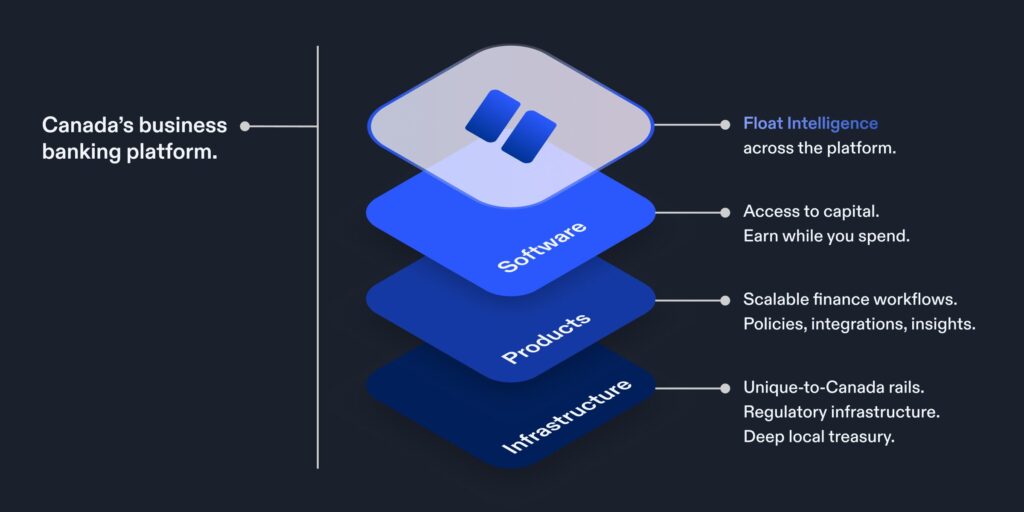
The modern finance stack can be understood as four layers that build on top of each other.
The first layer is financial infrastructure. Every business starts with the fundamentals: a business bank account, payment rails, corporate cards and an accounting system. These systems enable companies to store money, move money, and record financial activity.
The second layer is financial workflows. As businesses grow, they develop operational processes around how money moves through the company. This includes bill payments, spend management, reimbursements, approvals, vendor management and internal controls. These workflows sit on top of the payment infrastructure and must integrate deeply with it to work effectively.
This is where Float has focused much of its development. By bringing cards, bill payments, reimbursements, FX and banking into a single platform, we give finance teams end-to-end visibility and control over spending while enabling workflows that scale with the organization.
The third layer is data. As companies scale further, the ability to access and aggregate financial data becomes critical. Finance teams need to understand not only how money moves but what those movements mean for forecasting, planning, and strategic decision-making. This requires consolidating financial data across infrastructure and workflow systems into formats that can be analyzed programmatically.
Only once these three layers are in place does the fourth layer become possible: automation and AI.
AI systems rely on reliable infrastructure, well-structured workflows and accessible data. When those elements exist, it becomes possible to automate large parts of financial operations that previously required manual intervention.
The emerging automation layer
The most advanced finance teams are now beginning to experiment with this fourth layer.
Some are connecting modern development tools directly to financial data warehouses to automate FP&A workflows and reporting processes. Others are building automation around accounts receivable, enabling systems to manage invoicing and collections across large customer bases. Treasury functions are also becoming increasingly automated, with systems optimizing liquidity and yield behind the scenes.
What we are seeing is the early emergence of a new operating model for finance teams.
Instead of acting primarily as operators of financial systems, finance teams are beginning to design systems that operate automatically. The role of the finance team shifts from executing workflows manually to designing, monitoring, and improving automated financial processes.
The key constraint, however, is that companies cannot skip steps in the evolution of their finance stack.
Automation becomes fragile when infrastructure is fragmented, workflows are disconnected or financial data is difficult to access. The organizations that are succeeding with AI today are those that first solved layers one through three.
Because Float integrates infrastructure, workflow, and data within a single platform, we are now able to build the automation layer directly on top of that foundation. Over the coming quarters we will be introducing new capabilities designed to automate entire financial workflows end to end, particularly the tedious operational tasks that consume disproportionate time for finance teams.
What we believe the future of AI in finance looks like
At Float, we believe AI will fundamentally change how finance teams operate over the next decade. We are still in the early stages of this shift, but the direction is already clear. Much of the operational work that finance teams perform today exists because financial systems were historically unable to interpret context, connect across tools or automate complex workflows. As AI becomes more capable, many of those constraints begin to disappear.
There are several areas where we believe the impact will be most immediate. The first is the elimination of repetitive operational tasks that finance teams perform every day. Activities such as transaction coding, chasing employees for receipts and reconciling transactions at month-end are essential for maintaining financial accuracy, but they do not create strategic value for the business. With modern AI systems capable of interpreting receipts, understanding vendors, applying tax logic and verifying policies, we believe these workflows can increasingly be automated end to end.
The second area is data analysis and financial reporting. Finance teams spend a significant amount of time gathering data, formatting it and preparing it for analysis. AI will not necessarily replace financial judgment or strategic planning, but it will significantly accelerate the process of producing insights. Lightweight analytics, internal reporting and financial analysis will become much faster to generate, allowing teams to focus more on interpretation and decision-making rather than data preparation.
The third and perhaps most important shift will be orchestration across financial systems. Most companies today operate a fragmented finance stack made up of many different tools: banking systems, payment platforms, accounting software, internal communication tools and data systems. Each tool performs a specific function, but finance teams are responsible for stitching those systems together manually.
We believe the most powerful AI solutions will not be limited to a single tool. Instead, they will orchestrate workflows across many systems simultaneously.
Float already operates in this direction today. Our platform connects to multiple parts of the finance stack: it can gather receipts directly from finance inboxes, synchronize transactions with accounting systems and notify teams through tools like Slack when important financial events occur, such as incoming payments, card pauses or account changes. These integrations are early examples of how financial workflows can span multiple tools seamlessly.
Looking forward, we believe this level of integration will deepen significantly. The next generation of financial automation will not live inside a single product interface. Instead, it will operate as an orchestration layer that connects payments infrastructure, financial workflows, data systems and communication tools into a single coordinated experience.
In that future, finance teams will be able to automate workflows that span multiple systems at once, allowing financial operations to run faster and with far less manual coordination.
Advice for finance teams that want to operate at the edge of AI automation
The most effective finance teams today look very different from those of the past.
Historically, finance organizations scaled by adding people to manage operational complexity. Modern finance teams increasingly scale by building systems that eliminate that complexity.
The teams operating at the edge of AI automation share several characteristics.
First, they prioritize infrastructure. They ensure their financial systems are modern, integrated and accessible through APIs. Without this foundation, automation is difficult to achieve.
Second, they invest in workflows that scale. Instead of stitching together dozens of disconnected tools, they consolidate financial operations into systems that communicate with each other effectively.
Third, they treat financial data as a strategic asset. They centralize and structure financial data so it can be analyzed, queried, and automated against.
Once these foundations are in place, the most advanced teams begin experimenting aggressively with AI and automation tools. They automate reporting workflows, build intelligent approval systems, streamline accounts receivable and explore ways to reduce the operational overhead of finance functions.
The result is a very different type of finance organization. The finance team of the future will likely be leaner, more technical and significantly more leveraged. Instead of spending the majority of their time reconciling transactions, processing payments, and collecting data, they will focus on financial strategy, capital allocation and business decision-making. In other words, tomorrow’s finance leaders won’t be custodians of the past but leaders and architects of what comes next for the business.
Their systems will handle much of the operational work. In many ways, this shift mirrors transformations that have already happened in engineering, marketing and operations. The teams that succeed are not necessarily the largest teams. They are the teams that use the most effective systems.
The finance stack is undergoing the same transformation. And for the first time, the tools are beginning to exist that allow finance teams to truly operate at that level.
The only question now is which teams will lead that transformation and which ones will be left catching up. For Canada, the opportunity to lead has never been more within reach.
Written by

All the resources

Engineering
Productizing Uncertainty: How We Taught Our AI to Say “I Don’t Know”
Your LLM doesn’t know what it doesn’t know. So we built an AI system at Float that fixes that.
Read More
Corporate Cards
Best Car Rental Insurance Credit Cards in Canada: 2026 Edition
Car insurance is kind of like a seatbelt: boring until it’s absolutely essential at the worst possible moment.
Read More
Accounts Payable
AP Automation for Canadian Businesses: Streamline Accounts Payable
Let's look at how AP automation works, why it matters for Canadian finance teams and what to look for in
Read MoreSpend time and money
where it counts
Earn up to 4% interest on your cash balance and simplify business spending with corporate cards, accounts payable and expense management software.